12 Social Proof Statistics That Change How You Sell (2026 Data)
Backed by Northwestern, BrightLocal, and Podium research: 12 social proof statistics that actually matter for conversions, trust, and revenue growth in 2026.
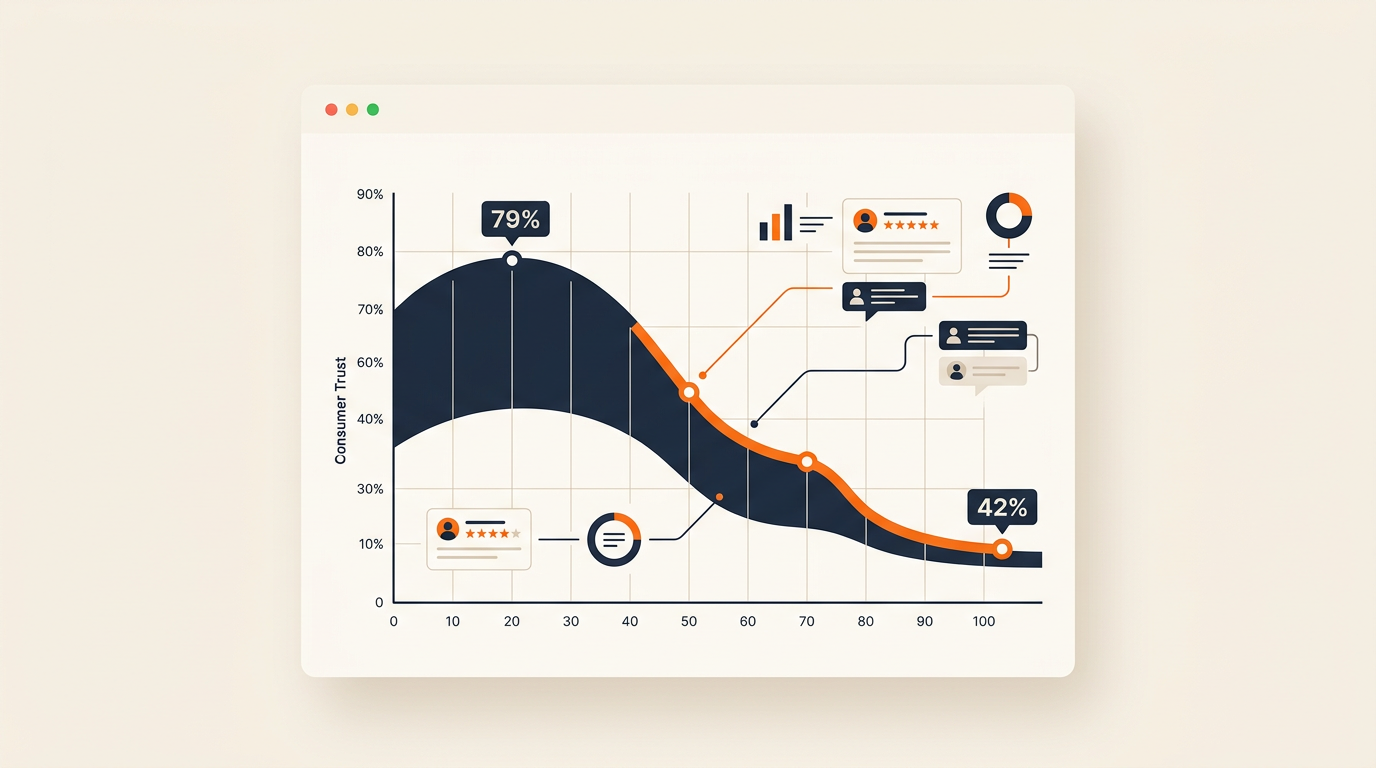
Trust in reviews is broken. Not gone, broken. In 2020, 79% of consumers trusted online reviews as much as personal recommendations. By 2025, that number collapsed to 42% (BrightLocal, 2026). People didn't stop reading reviews. They stopped believing them blindly.
That's the paradox sitting at the center of social proof in 2026. More people rely on reviews than ever before, 97% according to BrightLocal's latest survey, yet fewer people trust any single review the way they used to. The bar hasn't lowered. It's shifted.
This means the old playbook of collecting a handful of five-star reviews and slapping them on your homepage won't cut it. The businesses winning now understand volume thresholds, rating psychology, and where AI fits into the picture. These 12 statistics show exactly what's changed and what to do about it.
TL;DR: 97% of consumers still use reviews, but trust in individual reviews dropped nearly in half. The new rules: you need at least 5 reviews per product (for a 270% purchase lift), your rating sweet spot is 4.0-4.7 (not 5.0), and 45% of consumers now ask AI chatbots for recommendations instead of scrolling review pages.
Everyone Still Trusts Reviews, They Just Trust Them Differently
Social proof is the psychological principle where people copy what others do to figure out the right move -- and in marketing, nothing else comes close for building trust.
97% of consumers read online reviews before buying, and 93% say those reviews directly change whether they pull the trigger (BrightLocal, 2026; Podium, 2017). The audience hasn't left. They've just gotten pickier about what they believe.
The Trust Shift
Here's what actually shifted. Five years ago, a glowing review from a stranger carried the same weight as your friend saying "you should try this." That equivalence has been cut nearly in half. People now treat reviews more like research material than endorsements.
The numbers tell the story: in 2020, 79% of consumers trusted online reviews as much as personal recommendations. By 2025, that dropped to 42%. Fake reviews and AI-generated content flooded every platform, and people noticed.
This changes how you should think about your strategy. A single standout testimonial used to be enough to nudge someone over the line. Now buyers cross-reference. They read the negative reviews on purpose. They check dates, look for patterns, and skip anything that feels templated.
My take: The death of blind trust is actually good news for honest businesses. If you have a genuinely strong product, the new skepticism works in your favor. Fake reviews lose power. Real ones gain it.
The 4-Star Floor
57% of consumers won't even consider a business with less than a 4-star rating (BrightLocal, 2025-2026). That's not pickiness. That's a hard floor. If your average dips below 4.0, more than half your potential buyers disappear before they see your pricing page.
The lesson here isn't "get more reviews." It's "get more real, specific testimonials that hold up when a skeptical reader looks closely."
Five Reviews Is the Tipping Point Most Businesses Never Reach
Key finding: Products with 5 or more reviews are 270% more likely to be purchased than products with zero reviews (Spiegel Research Center, Northwestern, 2017).
That's not a typo. Nearly four times the purchase probability, triggered by just five reviews.
Why Most Businesses Stall at Zero
Most businesses never get there. Think about your own product pages. How many have zero or one review? The Spiegel data shows the biggest conversion jump happens between zero and five. After that, the gains taper off. Going from 5 reviews to 50 helps, but not nearly as much.
Here's the practical takeaway: five reviews is the minimum viable social proof. If you're running paid ads to product pages with fewer than five reviews, you're lighting money on fire. Fix the foundation before you scale the traffic.
How to Hit Five Fast
This is where having a real testimonial collection strategy pays off fast. You don't need hundreds of reviews. You need five solid ones per product, per service, per landing page. You can get there in a week if you ask the right customers at the right time.
| Review Count | Conversion Impact |
|---|---|
| 0 reviews | Baseline |
| 1-4 reviews | Moderate lift |
| 5+ reviews | 270% more likely to purchase |
| 50+ reviews | Diminishing additional gains |
For higher-priced products, the effect is stronger. Spiegel found that review impact goes up with price. A $100 item with five reviews sees a bigger lift than a $10 item with the same count. Makes sense -- buyers need more reassurance when they're spending more.
Perfect Ratings Are Killing Your Conversions
Products rated 4.0-4.7 stars have the highest purchase probability. A perfect 5.0 rating actually decreases trust and conversions (Spiegel Research Center, Northwestern, 2017). Your best rating isn't a perfect score. It's an imperfect one.
The Perfection Penalty
Most businesses get this completely wrong. They hide negative reviews, cherry-pick only the glowing ones, and chase a 5.0 average like it's the goal. It's not. A flawless score triggers the same skepticism you feel when every review on a product says "AMAZING BEST THING EVER."
My take: A few 3-star reviews are your secret weapon. They make the 5-star reviews believable. Stop panicking about imperfect ratings and start treating them as credibility anchors.
The conversion data forms a bell curve: purchase probability climbs from 3.5 stars, peaks around 4.2-4.5, then drops as ratings approach 5.0. The sweet spot is "great but not suspiciously perfect."
Use Flaws to Build Trust
Think of it like a restaurant recommendation. Your friend says "the pasta is incredible, but parking is terrible." You trust that review more than "everything was perfect, no notes." The flaw makes the praise land harder.
This should change how you display testimonials. Show range. Include the customer who said "setup took longer than expected, but the results were worth it." That review sells harder than ten generic five-star ratings.
Video Testimonials Aren't Optional Anymore

Consumers are 66% more likely to purchase after watching a testimonial video, and 77% say a video testimonial specifically convinced them to buy (Wyzowl, 2024). Text reviews still matter. Video reviews close deals.
Why Video Wins the Trust Battle
The gap between text and video keeps growing. Video is harder to fake. You can see the person's face, hear their voice, read their body language. When people already distrust written reviews, video gives them something text can't: proof that a real human said those words.
My take: If you're only collecting text testimonials, you're leaving the highest-trust format on the table. One authentic 60-second video outweighs a dozen written reviews for building buyer confidence.
Placement Multiplies the Effect
The placement data backs this up. Landing pages with video testimonials convert 39% higher than those without. Placing testimonials near the checkout or CTA increased purchases by 24% (Teleprompter.com / Influencer Marketing Hub, 2025).
VWO's A/B testing found that testimonials on sales pages increase conversions by up to 34% (VWO, 2024-2025). That's from placement alone, before you touch the content itself.
| Format | Conversion Impact | Trust Level |
|---|---|---|
| No testimonials | Baseline | Low |
| Text testimonials | Up to 34% lift | Medium |
| Video testimonials | Up to 39% lift | High |
| Video near checkout | Additional 24% lift | Highest |
Not sure which format fits your audience? Compare the tradeoffs in our breakdown of video vs text testimonials. The short answer: use both, but prioritize video for your highest-value pages. For guidance on optimal positioning, see where to place testimonials for maximum impact.
Your Customers Will Write Reviews If You Just Ask
72% of customers will leave a review when asked directly. Without prompting, only 1-2% leave reviews on their own (BrightLocal, 2024-2025; Podium, 2017). The gap between "willing" and "unprompted" is enormous.
The 36x Gap
That's a 36x difference between asking and hoping. Imagine having a sales channel that converts at 72% and just... not using it. That's what most businesses do with testimonial collection. They build great products, get great results for customers, and then never ask anyone to say so publicly.
My take: The testimonial bottleneck isn't willingness. It's initiative. Your customers aren't withholding praise. They just have 47 other things on their to-do list. A simple ask solves the entire problem.
Build a System, Not a Habit
The fix isn't complicated. It's operational. Build a system: identify the right moment, send the right ask, make responding effortless. We built Credibly's testimonial email generator for exactly this. It creates ready-to-send request emails that give customers a clear prompt instead of a blank page.
If you want the full playbook on timing, templates, and follow-ups, read our guide on how to ask for testimonials. The difference between companies drowning in social proof and those starving for it almost always comes down to one thing: whether they ask. One team even collected 47 testimonials in 30 days using a structured ask cadence.
AI Is Already Replacing Your Review Pages
Nearly half of consumers now ask AI chatbots for product recommendations instead of scrolling review pages. If your testimonials aren't structured for AI to parse, you're invisible to this audience.
Key finding: 45% of consumers now use ChatGPT or other AI tools to find local business recommendations, up from just 6% the prior year (BrightLocal, 2026).
Your customers are asking AI chatbots "what's the best CRM for small teams?" and acting on the answers.
The Discovery Channel You're Missing
Nobody's talking about this enough. While businesses obsess over Google star ratings and Yelp pages, nearly half of consumers have moved to a completely different discovery channel. And AI recommendations don't work like search results. There's no "page 1 ranking." The AI picks a few winners and everyone else doesn't exist.
My take: Generative Engine Optimization (GEO) is the next SEO. If your testimonials and reviews aren't structured in a way that AI models can parse and cite, you're invisible to nearly half your potential market. This isn't a future problem. It's a right-now problem.
What Makes AI Recommend You
So what makes AI recommend one business over another? Structured data. Consistent mentions across credible sources. Clear, specific customer outcomes. Generic reviews saying "great product" give AI nothing to work with. But a testimonial saying "reduced our onboarding time from 3 weeks to 4 days" gives it something concrete to cite.
This is where a Wall of Love page pulls double duty. It's social proof for human visitors and structured testimonial data that AI models can crawl and reference. With Credibly, your testimonials are organized in clean, indexable formats that work for both audiences.
The Revenue Math Most Companies Get Wrong
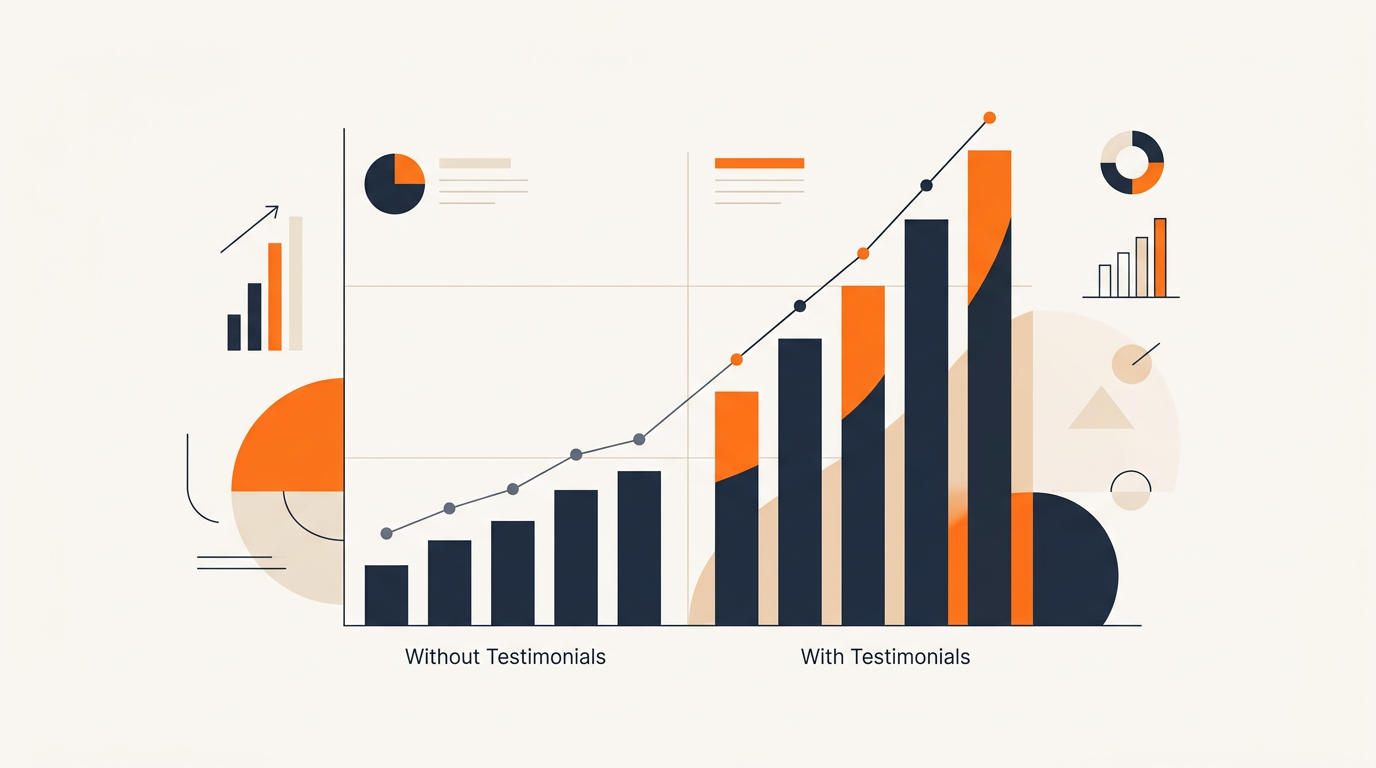
Strong reviews don't just bring in more buyers. They increase how much each buyer spends. Most ROI calculations miss this completely.
Key finding: Customers spend 31% more with businesses that have excellent reviews (Capital One Shopping / DemandSage, 2025).
That's not a conversion stat. That's a revenue-per-customer stat. People spend more when they feel confident about their purchase.
Running the Numbers
Let's make this concrete with a real example.
Scenario: An e-commerce store averaging $80 per order, 1,000 orders/month.
- Monthly revenue without strong reviews: $80,000
- Monthly revenue with excellent review profile (31% higher spend): $104,800
- Additional monthly revenue: $24,800
- Additional annual revenue: $297,600
That's nearly $300K in additional revenue from the same traffic, just because customers feel more confident spending. This doesn't account for the conversion lift from reviews (the 270% purchase probability increase), which would further multiply the total.
My take: Most companies calculate review ROI only on conversion rate improvements. They ignore the spend-per-customer multiplier entirely. When you stack both effects, the case for investing in testimonial collection becomes almost absurdly clear.
Benchmark Yourself
If you want to benchmark your own numbers, our conversion rate benchmarks break down what "good" looks like across industries. The businesses outperforming their category almost always share one trait: they collect and display social proof on purpose, not by accident.
UGC Beats Your Marketing Copy (The Data Says So)
Websites displaying user-generated content see 29% higher conversion rates compared to those relying solely on brand-created content (Trustmary, 2025). Your customers' words outperform your copywriter's words by nearly a third.
Why Unpolished Wins
This shouldn't surprise anyone, but it still catches marketing teams off guard. They spend weeks polishing landing page copy, A/B testing headlines, tweaking value propositions. Then a customer writes "this thing saved me 10 hours a week and my boss finally stopped micromanaging" and it outperforms everything.
My take: UGC works because it's specific, unpolished, and credible in ways that brand copy can never be. The misspelling, the casual tone, the weirdly specific detail about their boss. That's what makes it convert. Stop cleaning it up.
Word-of-Mouth at Scale
Think of it as word-of-mouth at scale. A friend recommending a restaurant doesn't use marketing language. They say "the burrata appetizer is insane and the parking lot is a nightmare but go anyway." UGC carries that same energy. It reads like a conversation, not an ad.
The contrast is clear: polished brand copy like "Our platform saves teams hours every week" consistently loses to raw customer language like "this thing saved me 10 hours a week and my boss finally stopped micromanaging." The messy version converts 29% better because specificity beats polish.
Look at how Stripe uses social proof across their site. They let customer stories do the heavy lifting. The brand copy sets context. The UGC delivers the punch. That's the model worth replicating.
If you want to start building your own UGC library, Credibly's Wall of Love collects, curates, and displays customer content in a format that works on any page. No developer needed. No code to maintain.
Key Takeaways
Before you jump to the FAQ, here are the stats that should shape your social proof strategy right now:
- Five reviews per product is the magic number. That's where the 270% purchase lift kicks in. Below five, you're leaving the biggest conversion gains untouched.
- Stop chasing a 5.0 rating. The conversion sweet spot is 4.0-4.7 stars. A few imperfect reviews make the positive ones more believable.
- Just ask. The gap between 1-2% unprompted reviews and 72% when you ask directly is the single easiest win in your entire marketing stack.
- Video closes deals that text can't. 77% of consumers say a video testimonial specifically convinced them to buy. Prioritize video for your highest-value pages.
- AI is the new review page. 45% of consumers already ask AI chatbots for product recommendations. Structure your testimonials so AI models can parse and cite them.
- Reviews increase order size, not just conversion rate. Customers spend 31% more when your review profile is strong. Most ROI calculations miss this entirely.
Frequently Asked Questions
Can too much social proof actually hurt conversions?
Yes, and nobody talks about it. When a page is crammed with testimonials, star ratings, trust badges, customer counts, and video reviews all at once, the buyer's brain just shuts down. Psychologists call it "choice overload."
My take: Social proof follows the same rule as seasoning. The right amount makes the dish. Too much ruins it. Pick your two strongest proof points per page and let them breathe. A cluttered trust section looks desperate, and desperation kills trust faster than a 3-star review.
The sweet spot is 2-3 testimonials per landing page section, strategically placed near decision points. If you're embedding a full Wall of Love, give it its own dedicated page rather than cramming it below the fold.
What's the minimum number of reviews needed to influence buyers?
Five reviews per product is the threshold where the major conversion lift occurs, based on the Spiegel Research Center data. Below five, you get some benefit but the curve is steep. At five, you hit the 270% purchase probability increase. Beyond that, more is better but the marginal gains shrink.
For service businesses, aim for 10-15 testimonials on your main pages. This gives buyers enough variety to find someone who looks like them, faced the same problem, and got a result they want. Check our guide on testimonial collection strategies for a repeatable system to hit those numbers.
Are star ratings or written testimonials more important for conversions?
Different jobs. Star ratings are a filter (remember, 57% won't consider below 4 stars). Written testimonials are a closer. You need both, but they work at different points in the buying process.
Star ratings get you into the consideration set. Testimonials get you the sale. If you have to pick one to invest in first, get your star rating above 4.0. Then pour energy into collecting detailed, specific customer testimonials that address the exact objections your buyers have. You can compare tools for managing both on our testimonial software alternatives page.
These 12 statistics tell one story: social proof in 2026 rewards specificity and authenticity over perfection and volume. The businesses winning right now don't have the most reviews. They have the right ones, in the right places, in formats that both humans and AI can trust.
The gap between businesses that collect testimonials on purpose and those that don't keeps growing. Every day without a system is another day your happy customers stay quiet while your competitors' customers speak up.
Start your free trial of Credibly today and turn your customer wins into the social proof that actually drives revenue.
Written by Credibly Team
We help businesses collect and display customer testimonials that actually convert. No awkward asks. No scattered screenshots. Just social proof that works.
Try Credibly FreeAlso comparing tools? Explore testimonial software alternatives.
Continue Reading
Ecommerce Testimonial Examples: 11 Brands Doing It Right
Real ecommerce testimonial examples from 11 brands driving sales with reviews. Products with 5+ reviews are 270% more likely to sell. Tactics included.
How to Collect Testimonials: Build a System That Scales
72% of customers leave reviews when asked, yet most businesses collect zero. Build a testimonial collection engine with proven timing, channels, and automation
SaaS Testimonial Examples: 11 Companies Doing It Right
See how 11 SaaS companies use testimonials to boost conversions by up to 34%. Real examples with steal-worthy tactics and data-backed strategies inside.