Customer Testimonials: The Complete Guide to Types, Collection, and Strategy
Products with reviews see 270% higher purchase likelihood (Spiegel Research). Learn testimonial types, collection systems, and strategies that build real trust.
Customer Testimonials: The Complete Guide to Types, Collection, and Strategy
Let's be honest. Your marketing copy says you're great. Your testimonials prove it.
That's not a small difference. It's the entire difference. Products with reviews see 270% higher purchase likelihood than products with zero reviews (Spiegel Research Center, 2017). Not 10% higher. Not 50% higher. Two hundred and seventy percent.
And yet, most businesses treat testimonials as an afterthought. A few quotes on the about page. A carousel nobody clicks. Sound familiar?
This guide breaks down what customer testimonials actually are, the types that matter, how to collect them without it feeling awkward, and how to turn them into a real conversion engine. It's the hub for everything we've written about testimonials, so I'll point you to deeper dives along the way.
TL;DR: Products with reviews convert 270% better than those without (Spiegel Research Center, 2017). Customer testimonials are curated endorsements from real users that reduce buyer hesitation and build trust. This guide covers the seven major types, proven collection methods, and display strategies that actually move the needle on revenue.
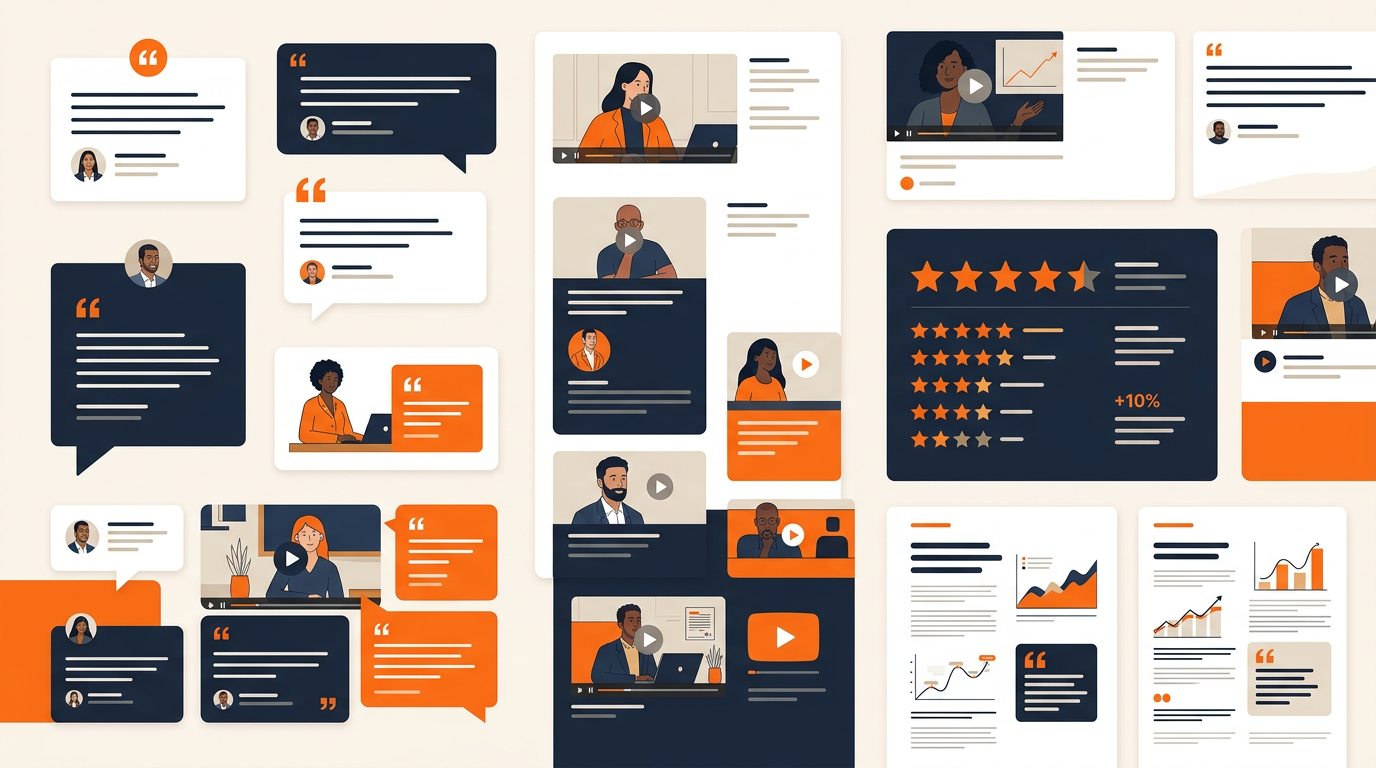
What Are Customer Testimonials (and What They're Not)
A customer testimonial is a statement from a real user about their experience with your product or service. 97% of consumers rely on reviews when deciding whether to buy (BrightLocal, 2026). That's basically everyone.
But people mix these up. A testimonial isn't the same as a review. Reviews are uncontrolled. They show up on Google, G2, Yelp, and they can be glowing or brutal. Testimonials are curated. You collected them, got permission, and chose to display them. You control the narrative.
My take: I've seen companies treat testimonials and reviews interchangeably, and it always backfires. Reviews are about credibility through volume. Testimonials are about persuasion through specificity. You need both, but they do different jobs.
The Anatomy of a Strong Testimonial
The best testimonials follow a simple structure. A before state, an action, an after result. "I was struggling with X, tried Y, and now Z has changed." That's a mini success story, not generic praise.
Weak testimonials say "Great product!" Strong ones say "We cut our onboarding time from 3 weeks to 4 days after switching." See the difference? The specific one gives prospects something to anchor on.
Why "Great Product" Testimonials Are Worthless
Vague praise doesn't move anyone closer to buying. When someone reads "Amazing service, highly recommend!", their brain files it as noise. But a testimonial with a named result and a real pain point? Something clicks. They see themselves in the story.
This is why collecting the right testimonials matters more than collecting many testimonials. Five specific, outcome-driven quotes will outperform fifty empty ones every time.
Most Companies Get Testimonials Wrong. Here's Why.
Key finding: 92% of consumers hesitate to purchase when no reviews or testimonials are available (Podium, 2025).
That should tell you testimonials aren't optional. But most businesses mess this up in three predictable ways.
They wait too long to ask. The best time to capture a testimonial is right after a win. Not three months later when the excitement has faded and the customer barely remembers the details.
They don't have a system. Collecting testimonials on a "when we remember" basis produces exactly what you'd expect: nothing. You need triggers, templates, and follow-up sequences.
They display testimonials like an afterthought. A carousel buried below the fold is a wasted asset. Placement and context decide whether testimonials actually change buying decisions. I've seen teams with great testimonials that do nothing because they're hidden on a page nobody visits.
My take: The biggest testimonial mistake I see isn't having bad testimonials. It's having good ones that are invisible. If your best social proof lives on page 4 of your website, you don't have a testimonial problem. You have a distribution problem.
For a complete system that fixes this, our practical guide to asking for testimonials covers timing, templates, and follow-up scripts.
The 7 Types of Customer Testimonials (and When to Use Each)
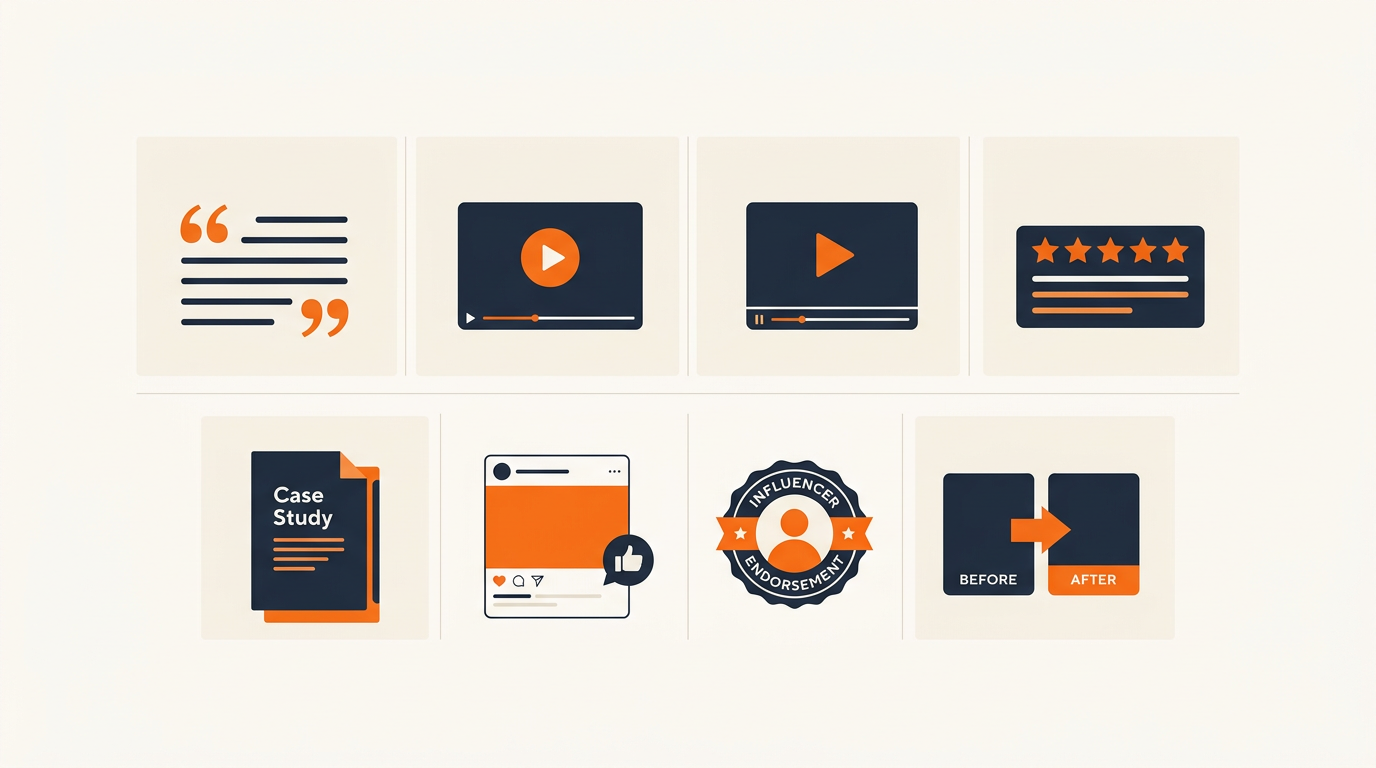
Different testimonial formats work at different stages of the buying process. They require different effort to produce and carry different weight with prospects. Here's how each one works.
1. Quote Testimonials
The workhorse. A short written statement with a name, title, and optionally a photo. Easy to collect, easy to display. Works on landing pages, in emails, on social posts, in print. The tradeoff: text alone doesn't carry as much emotional weight as video or case studies.
2. Video Testimonials
57% of video marketers now use testimonial videos (Wyzowl, 2026). Video shows facial expressions, tone of voice, and real emotion in ways text just can't. The catch: they're harder to collect and produce.
My take: Don't overthink video quality. A customer recording a genuine 90-second clip on their phone beats a scripted studio production every time. Authenticity always trumps polish.
For a deeper comparison of when video outperforms text (and when it doesn't), check out our video vs text testimonials analysis.
3. Social Media Testimonials
Unsolicited praise on Twitter, LinkedIn, or Instagram. These feel authentic because nobody asked for them. The customer was excited enough to share on their own. Screenshot them with permission and embed them on your site. Seeing the platform context (the tweet UI, the LinkedIn post format) adds instant credibility.
4. Case Studies
Testimonials expanded into full narratives with challenges, solutions, and measurable outcomes. Case studies are the most persuasive format for B2B, where decision-makers need to justify purchases to a committee. They take real work to produce, but they carry serious weight.
5. Peer Review Site Ratings
Third-party reviews on Google, G2, Capterra, or Yelp. You don't control these, which is exactly why they're powerful. An aggregate score like "4.8 from 500 reviews" provides quick-scan social proof that doesn't require reading a single review.
6. Influencer and Expert Endorsements
When someone with an audience endorses your product, you borrow their credibility. Trust transfers. If your prospect already trusts the recommender, they'll trust the recommendation too. Just disclose any sponsorship. People can smell inauthenticity from a mile away.
7. Interview-Based Testimonials
Instead of asking customers to write something (which feels like homework), you interview them. Ask questions, record the conversation, edit the responses into finished content. You get richer material and the customer has an easier time. They just answer questions instead of staring at a blank page.
| Testimonial Type | Collection Effort | Credibility | Best Use Case | Conversion Impact |
|---|---|---|---|---|
| Quote | Low | Medium | Landing pages, emails | Moderate |
| Video | High | Very High | Homepage, sales pages | High |
| Social Media | None (organic) | High | Social proof sections | Moderate |
| Case Study | Very High | Very High | B2B sales, proposals | Very High |
| Peer Reviews | Low (encourage) | High | Trust signals, search | High |
| Influencer | Medium | High | Brand awareness | Moderate-High |
| Interview | Medium | High | Blog, detailed pages | High |
How to Collect Customer Testimonials (Without Being Awkward)
Getting testimonials isn't about the perfect script. It's about timing, having a system, and making it stupid easy for customers to say yes.
Key finding: 72% of customers will leave a review if they're simply asked, yet only 1-2% actually do it unprompted (Podium, 2025).
That gap represents your opportunity.
Nail the Timing
Ask when the customer has just had a win. Not when you think they're happy, but when they've actually said so. After a successful launch. After they thank your support team. After they hit a milestone with your product. That's your window.
My take: I've found the best results come from the first 48 hours after a positive moment. Wait a week and response rates drop off a cliff. The emotion fades, the details get fuzzy, and suddenly it feels like a chore instead of a natural next step.
Build a System, Not a One-Off
The difference between companies with 3 testimonials and companies with 300 is almost never about having more customers. It's about having a system. You need:
- Trigger-based requests: Automate asks after key events (onboarding complete, support ticket resolved, NPS score of 9 or 10)
- Email templates: Pre-written messages that make the ask feel personal without requiring you to write from scratch each time
- Follow-up cadence: One ask, one reminder, one final nudge. Most conversions happen on the second or third touch.
For copy-paste templates you can steal right now, check our testimonial request strategies post. And if you want a tool that generates personalized request emails, try the free testimonial email generator.
Make the Response Effortless
The biggest reason customers don't respond isn't that they don't want to. It's friction. "Write us a testimonial" is a vague, open-ended task. Nobody wants to stare at a blank text box wondering what to say.
Instead, give them structure:
- "What problem were you trying to solve?"
- "How has [Product] helped?"
- "What specific results have you seen?"
Three questions. Takes two minutes. Produces a testimonial that actually tells a story.
The NPS-to-Testimonial Pipeline
If you run Net Promoter Score surveys, you already know who your happiest customers are. Promoters (scores of 9-10) are your prime testimonial candidates. Set up an automatic follow-up: "You rated us 9/10. Would you mind sharing a quick sentence about your experience?"
This works because you're not cold-asking for a favor. You're following up on a positive signal the customer already gave you.
Where and How to Display Testimonials for Maximum Impact
Collecting testimonials is half the work. The other half is putting them where they'll actually change minds.
Key finding: Testimonials placed on sales pages increase conversions by 34% (BigCommerce, 2023).
But placement matters more than most people realize.
Match Testimonials to Objections
This is the most underused tactic in testimonial strategy. Don't scatter social proof randomly. Map your testimonials to specific buyer objections and place them where those objections come up.
- Pricing page: Feature testimonials about ROI and value
- Feature pages: Show testimonials about specific capabilities
- Checkout/signup: Display testimonials from similar companies that took the leap
My take: Stop treating all testimonials as interchangeable. A testimonial about your customer support doesn't belong on the pricing page. A testimonial about ROI doesn't belong on the features page. The right testimonial in front of the right person at the right moment is worth more than a hundred randomly placed quotes.
For detailed placement zones and layout examples, our testimonial placement guide goes deep.
The 3-5 Rule for Key Pages
Research suggests 3-5 testimonials on key pages is the sweet spot. More than that and visitors stop reading. Fewer than that and it doesn't feel like social proof. It feels like your mom and your college roommate wrote nice things.
Use the rest in a dedicated Wall of Love page where visitors who want to browse deeper can explore at their own pace.
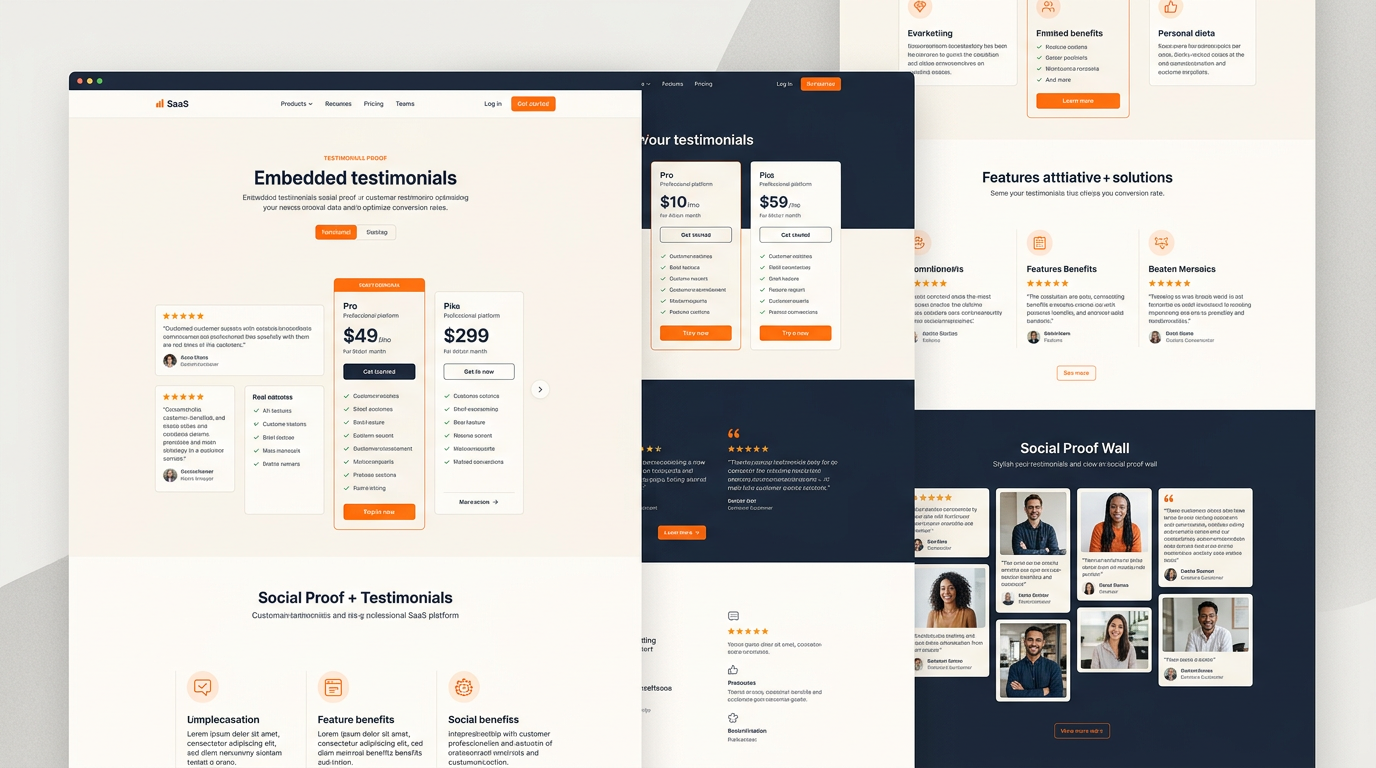
Display Formats That Convert
| Display Format | Best For | Conversion Lift | Effort to Build |
|---|---|---|---|
| Hero quote (single) | Homepage, above fold | High | Low |
| Carousel | Landing pages | Medium | Low |
| Grid/Wall of Love | Dedicated proof page | Medium | Medium |
| Inline contextual | Next to features/pricing | Very High | Medium |
| Video embedded | Sales pages | Very High | High |
| Marquee scroll | Visual engagement | Low-Medium | Low |
For real-world layout examples with conversion data, see testimonial display examples that convert.
The Trust Equation Has Changed. Your Testimonials Need to Adapt.
Trust in online reviews has eroded fast. Your testimonial strategy needs to account for that.
Key finding: Trust in online reviews dropped from 79% in 2020 to 42% in 2025 (BrightLocal, 2026).
People didn't stop reading reviews. They stopped trusting them blindly.
What happened? Fake reviews flooded every platform. Consumers got burned. AI-generated content made it even harder to tell what's real. The bar for authenticity went way up.
My take: This is actually good news if you're doing testimonials right. When trust in generic five-star reviews craters, verified, specific, human testimonials become way more valuable. The winners here aren't the companies with the most reviews. They're the ones with the most believable reviews.
What Makes a Testimonial Believable in 2026
- Full attribution: Name, title, company, photo. "Sarah C." doesn't cut it anymore.
- Specificity: Concrete numbers, named outcomes, real timelines.
- Imperfection: Testimonials that mention a minor challenge before praising the solution feel more authentic than pure praise.
- Recency: 73% of consumers only trust reviews from the last month (BrightLocal, 2026). Old testimonials signal "this company used to be good."
- Third-party verification: Link to the reviewer's LinkedIn or the original review platform when possible.
Verified Buyers Convert Better
The Spiegel Research Center found that purchase likelihood goes up 15% when reviews come from verified buyers versus anonymous sources (Spiegel Research Center, 2017). Verification removes doubt. When a prospect can see that the reviewer actually bought and used the product, the testimonial hits different.
The "Perfect Rating" Trap
Products with a perfect 5.0 rating actually convert worse than those in the 4.2-4.7 range (Spiegel Research Center, 2017). Nobody believes perfection. A slightly imperfect score feels more real.
My take: I've seen this firsthand. A SaaS company I worked with removed two 3-star reviews from their testimonials page, pushing their average to 5.0. Conversions dropped. They put the 3-star reviews back, added thoughtful responses to each, and conversions went up 12%. Imperfection + responsiveness beats manufactured perfection.
Building a Testimonial Engine (Not a One-Time Project)
The companies with the strongest social proof didn't get there through a single campaign. They built systems that generate testimonials continuously. Here's how to do that.
Step 1: Create Feedback Loops
Every customer touchpoint is a potential testimonial moment. Map them out:
- Post-purchase confirmation
- After onboarding completion
- After a support ticket resolution
- After a milestone achievement (first 100 uses, 1-year anniversary)
- After contract renewal
Step 2: Use AI to Surface the Best Material
Some testimonials are genuinely persuasive. Others are nice but forgettable. AI-powered sentiment analysis can score them for specificity, emotional impact, and relevance to different buyer objections.
Credibly analyzes every testimonial across 10 dimensions -- pain points addressed, outcomes described, funnel stage relevance. Instead of manually reading through hundreds of quotes to find the right one, you just search by use case.
Step 3: Distribute Strategically
This is where most teams fall apart. They collect great testimonials, store them somewhere, and forget about them. Build a distribution map:
- Homepage: 3-5 best overall testimonials
- Pricing page: ROI-focused testimonials
- Feature pages: Feature-specific testimonials
- Email campaigns: Rotate fresh testimonials in drip sequences
- Sales decks: Industry-matched case studies
My take: The goal isn't just to collect testimonials. It's to build a searchable, organized library that sales and marketing can pull from instantly. When a prospect asks "do you work with companies in healthcare?", your team should find a relevant testimonial in under 30 seconds.
How Credibly Turns This Into a System
Here's how Credibly can turn this chore into a conversion engine:
- Automate the ask: Send branded testimonial request emails at the right moment. Customers land on a custom collection page where they can submit in under 2 minutes.
- AI analysis surfaces the best quotes: Every testimonial gets scored across 10 dimensions. You instantly know which ones are high-impact and which page they belong on.
- Display without code: Choose from 14 widget styles, customize with a visual builder, and embed with a single line of code. No developer needed.
Start your free trial of Credibly today and see the difference organized social proof makes.
FAQs About Customer Testimonials
Here are the quick, no-nonsense answers to the questions I get asked every single time.
What's the difference between a testimonial and a review?
A testimonial is a curated, positive statement you've collected with permission. A review is feedback posted on a third-party platform (Google, G2, Yelp) that can be positive, negative, or anywhere in between. You control which testimonials appear on your site. Reviews are outside your control, which is part of why they carry weight.
How many testimonials do I actually need?
It depends on where you're using them. For key pages (homepage, pricing), 3-5 strong testimonials is the sweet spot. For a dedicated testimonials page or Wall of Love, aim for 20+. Research from Spiegel shows the biggest conversion jump happens from zero to five reviews. After that, the marginal benefit per additional testimonial flattens.
Can I edit customer testimonials?
Minor edits for grammar, clarity, or length are fine. But always get approval and never change the meaning. Fabricating or heavily rewriting testimonials is dishonest, potentially illegal, and will catch up with you. Keep the customer's voice intact.
The real question isn't whether you can edit testimonials. It's whether you're collecting them well enough that editing is unnecessary. Give customers structured prompts and you'll get usable quotes straight from the source.
Do video testimonials actually convert better than text?
Video testimonials increase conversion rates by up to 80% compared to text alone (Wyzowl, 2026). But they're harder to collect, and some audiences prefer scanning text. Best approach: lead with video on high-stakes pages, use text everywhere else. Our video vs text deep dive has the full comparison.
What if I'm just starting out and have zero testimonials?
Start with your first five customers. Every business has at least a few people who had a good experience. Email them personally (not a mass blast) with a specific question about their results. If you're pre-revenue, use beta tester feedback or adviser endorsements. Anything is better than an empty testimonials section.
Key Takeaways
- Testimonials aren't optional. Products with reviews see 270% higher purchase likelihood. Zero social proof means zero trust for new visitors.
- Seven types, seven different jobs. Match the testimonial format (quote, video, case study, social media, review, influencer, interview) to the buyer stage and objection.
- Collection needs a system, not a campaign. Trigger-based requests, templates, and follow-up sequences beat ad-hoc asking every time.
- Placement trumps volume. The right testimonial next to the right objection outperforms a hundred randomly scattered quotes.
- Trust has shifted. Generic five-star praise converts less than it used to. Specificity, verification, and recency are the new trust signals.
- Build a library, not a collection. Organize, tag, and score testimonials so you can pull the perfect one for any context in seconds.
Turn Your Best Customers Into Your Best Marketers
Ready to stop treating testimonials like an afterthought? Credibly consolidates feedback from 20+ sources, uses AI to surface the quotes that actually convert, and lets you embed beautiful social proof with a single line of code.
Start your free trial of Credibly today and see how easy it is to build a testimonial engine that runs on autopilot.
Written by Credibly Team
We help businesses collect and display customer testimonials that actually convert. No awkward asks. No scattered screenshots. Just social proof that works.
Try Credibly FreeAlso comparing tools? Explore testimonial software alternatives.
Continue Reading
How to Collect Testimonials: Build a System That Scales
72% of customers leave reviews when asked, yet most businesses collect zero. Build a testimonial collection engine with proven timing, channels, and automation
Ecommerce Testimonial Examples: 11 Brands Doing It Right
Real ecommerce testimonial examples from 11 brands driving sales with reviews. Products with 5+ reviews are 270% more likely to sell. Tactics included.
SaaS Testimonial Examples: 11 Companies Doing It Right
See how 11 SaaS companies use testimonials to boost conversions by up to 34%. Real examples with steal-worthy tactics and data-backed strategies inside.