B2B Testimonial Examples: 15 That Actually Drive Revenue
See 15 real B2B testimonial examples sorted by type, with copy-paste templates. Plus data on why B2B buyers trust peer reviews over sales pitches.
B2B testimonials have a harder job than B2C ones. They need to convince multiple stakeholders who care about ROI, specific outcomes, and whether the person quoted actually has authority.
Let's be honest: your B2B testimonials are probably doing nothing for you.
They're sitting on a dusty page nobody visits, saying generic things like "Great product, would recommend!" while your sales team struggles to close deals. 92% of B2B buyers are more likely to purchase after reading a trusted review (Trustmary, 2025). But "trusted" is doing a lot of work in that sentence. Generic praise doesn't build trust. Specifics do.
I've spent years studying what separates B2B testimonials that sit idle from ones that actually show up in proposals, shorten sales cycles, and close deals. The difference isn't luck. It's structure.
TL;DR: 92% of B2B buyers purchase after reading trusted reviews, yet most B2B testimonials are too vague to influence anyone. This post breaks down 15 real B2B testimonial examples across five categories, with copy-paste templates for each. You'll see exactly why specific, results-driven quotes outperform generic praise every time.
Most B2B Testimonials Are a Complete Waste of Space
79% of B2B buyers rely on social proof when making purchasing decisions (WiserNotify, 2026). But relying on social proof and being persuaded by your testimonials are two different things. The average B2B testimonial reads like it was written by a committee. Safe. Bland. Completely forgettable.
Here's what I see constantly: "We've had a great experience with [Company]. Their team is professional and responsive." That tells a prospect absolutely nothing. It doesn't address their pain, doesn't quantify results, and definitely doesn't help them justify a $50K purchase to their CFO.
The B2B buying group now involves an average of 8.2 stakeholders (CorporateVisions, 2026). Your testimonial needs to convince the end user, their manager, procurement, finance, and probably legal. Vague praise doesn't survive that gauntlet.
My take: If your testimonial wouldn't help a champion sell your product internally during a budget meeting, it's not doing its job. The bar for B2B testimonials is much higher than B2C because the stakes are higher.
The 5 Types of B2B Testimonials That Actually Work
Not all testimonials do the same thing. The best B2B companies collect different types and use them at different points in the buyer's journey. Here's how it breaks down.
| Testimonial Type | Best For | Funnel Stage | Persuasion Lever |
|---|---|---|---|
| Results-Driven | Proving ROI to finance | Decision | Hard numbers |
| Problem-Solution | Building empathy with end users | Consideration | Pain recognition |
| Executive Endorsement | Winning C-suite buy-in | Decision | Authority |
| Implementation Story | Reducing adoption anxiety | Consideration | Ease of use |
| Comparison | Displacing competitors | Decision | Direct contrast |
Let me walk through three examples of each type, show you why they work, and give you a template to collect your own.
Results-Driven Testimonials (The Revenue Proof)
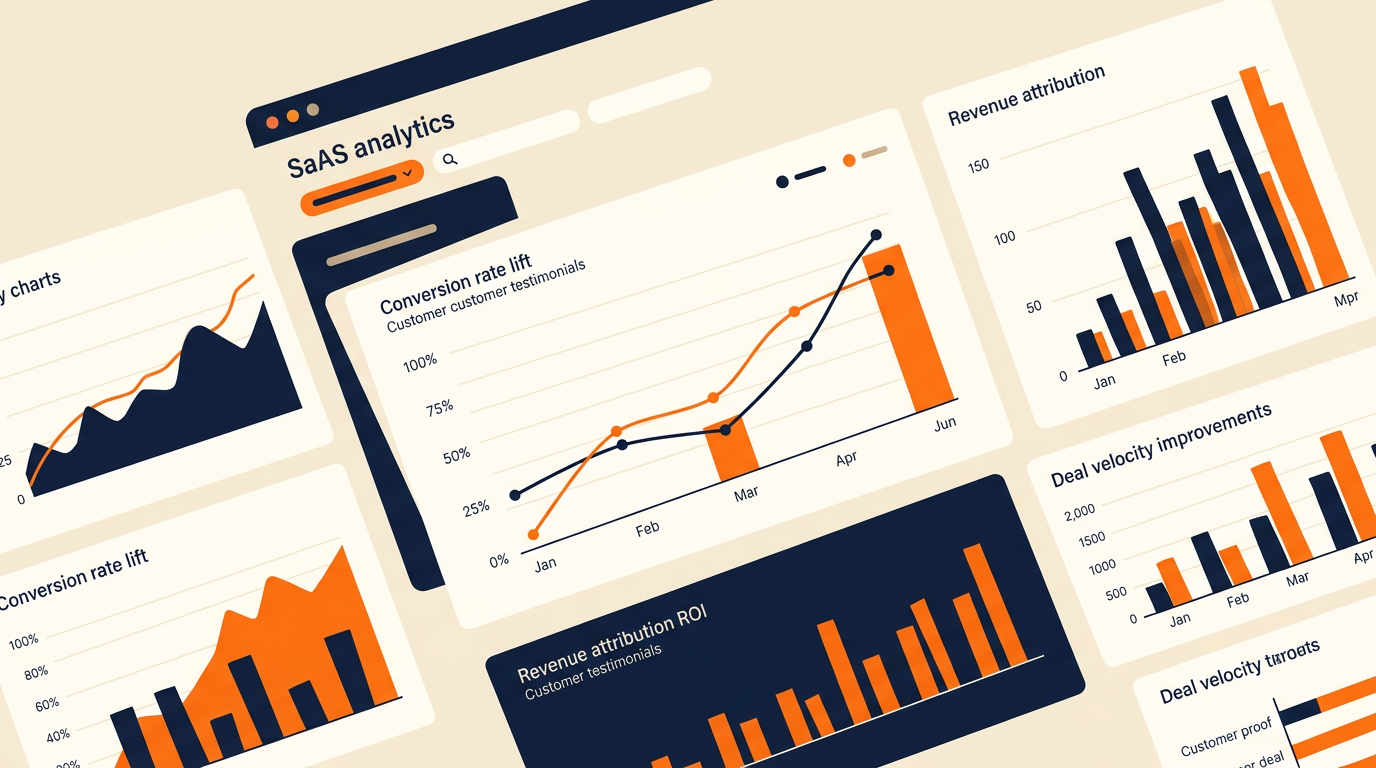
Key finding: Adding testimonials to sales pages increases conversions by 34% (VWO, 2025).
Results-driven testimonials are the heavy hitters. They lead with specific metrics that a CFO can put in a spreadsheet.
Example: Mid-Market SaaS — Revenue Metric
Why it works: Dollar amounts and percentages make the ROI self-evident. "$2.3M in additional ARR" means nobody needs to guess whether this was worth the investment.
"Since implementing [Product], our sales team has closed 40% more enterprise deals per quarter. That's $2.3M in additional ARR that we can directly attribute to faster proposal turnaround times."
- VP of Sales, Mid-Market SaaS Company
Template you can steal:
"Since implementing [Product], our team has [specific metric improvement]. That's [dollar amount or business impact] that we can directly attribute to [specific feature or capability]."
Example: Enterprise SaaS — Time-Saved Metric
Why it works: Before-and-after numbers tell a story on their own. "6 weeks to 9 days" is dramatic, and the headcount detail addresses the unstated question: "Will we need to hire more people?"
"We cut our customer onboarding time from 6 weeks to 9 days. Our CS team went from handling 3 new accounts per month to 12, without adding headcount."
- Head of Customer Success, Enterprise SaaS
My take: Time-saved testimonials are underrated in B2B. Every buyer understands that time equals money. If you can show someone getting their evenings back, that resonates on a personal level that pure revenue metrics sometimes miss.
Template:
"We cut our [process] time from [before] to [after]. Our team went from [old capacity] to [new capacity], without [expected cost]."
Example: B2B Services Firm — Efficiency Percentage
Why it works: The "first time in two years" detail adds weight. This wasn't a marginal improvement — it solved a problem they'd been struggling with for a long time.
"Our support ticket resolution time dropped 62% in the first month. We're now hitting our SLA targets for the first time in two years."
- Director of Operations, B2B Services Firm
Template:
"Our [key metric] improved by [percentage] in [timeframe]. We're now [achieving outcome] for the first time in [period]."
Problem-Solution Testimonials (The Empathy Builders)
65% of B2B buyers rate peer reviews and user-generated feedback as "very important" when evaluating solution providers (Trustmary, 2025). Problem-solution testimonials work because they mirror the buyer's own situation. When a prospect reads about someone who had the same pain, the product becomes the obvious answer.
Example: Series B Startup — Drowning in Spreadsheets
Why it works: "47-tab spreadsheet" is painfully specific and immediately relatable. The emotional shift ("look forward to meetings") seals it.
"Before [Product], we were tracking customer feedback in a 47-tab spreadsheet. Things fell through the cracks constantly. Now everything's in one place, tagged and searchable. I actually look forward to our weekly review meetings."
- Product Manager, Series B Startup
Example: Mid-Market SaaS — Integration Nightmare
Why it works: It lists the exact tools and pain points that prospects in similar roles experience daily. The "about an hour" detail makes implementation feel trivial.
"We had data in Salesforce, feedback in Intercom, reviews on G2, and NPS scores in a completely separate tool. Pulling a report meant logging into four platforms. [Product] consolidated everything in a single dashboard in about an hour."
- Revenue Operations Lead, Mid-Market SaaS
My take: Problem-solution testimonials are your best weapon for the middle of the funnel. At this stage, buyers aren't comparing features. They're asking "Does this company understand my problem?" A testimonial that describes their exact pain does that work for you.
Template:
"Before [Product], we were [specific painful process]. Things [specific negative consequence] constantly. Now [specific improvement]. I [emotional/personal benefit]."
Example: Enterprise E-Commerce — We Tried Everything
Why it works: "Three different tools in 18 months" positions the customer as a thorough evaluator. Their endorsement carries extra credibility because they've tried the alternatives.
"We went through three different tools in 18 months. None of them could handle our volume without breaking. [Product] was the first platform that scaled with us from 500 to 5,000 monthly reviews without any performance issues."
- VP of Customer Experience, Enterprise E-Commerce
Template:
"We went through [number] different [tools/approaches] in [timeframe]. None of them could [specific requirement]. [Product] was the first that [specific capability] without [expected drawback]."
Executive Endorsements (The Authority Play)
Enterprise B2B buyers respond most to detailed case studies with real ROI numbers, followed by testimonials from brands they recognize (Sopro, 2025). When a CTO or CEO puts their name on a quote, it tells the reader this wasn't a small experiment. It was a strategic bet.
Example: Series C SaaS — CEO Stamp of Approval
Why it works: "Told our board" raises the stakes. A CEO putting their reputation on the line for a product recommendation is as strong as B2B endorsements get, and the churn number makes it measurable.
"I told our board that [Product] was the single best technology investment we made this year. That's not something I say lightly. It directly contributed to a 28% reduction in churn, which, at our scale, means millions in retained revenue."
- CEO, Series C SaaS Company
Example: FinTech Startup — CTO Technical Validation
Why it works: "Seven platforms over three months" shows thorough evaluation. Technical buyers respect rigor, and the three dimensions named are exactly what other CTOs care about.
"Our engineering team evaluated seven platforms over three months. [Product] won on every dimension that mattered: API reliability, documentation quality, and integration speed. We had it in production in under two weeks."
- CTO, FinTech Startup
My take: I've found that executive endorsements work best on pricing pages and in sales proposals. When someone's about to sign a contract, seeing that a CEO at a similar company made the same bet gives them the confidence to move forward.
Template:
"I told [internal stakeholder/group] that [Product] was [strong endorsement]. That's not something I [say/do] lightly. It directly contributed to [specific business outcome], which at our scale means [dollar impact]."
Example: B2B SaaS — VP of Marketing Attribution
Why it works: "35% of pipeline" is a number that gets budget approved. The mindset shift ("revenue channel, not a nice-to-have") reframes the product's value at a strategic level.
"We can now attribute 35% of our pipeline to pages where [Product] testimonials are displayed. That attribution was invisible before. It's changed how our entire team thinks about social proof as a revenue channel, not a nice-to-have."
- VP of Marketing, B2B SaaS
Template:
"We can now [specific capability] that was [invisible/impossible] before. [Specific metric]. It's changed how our team thinks about [category] as [strategic reframe]."
Implementation Testimonials (The Anxiety Killers)
86% of B2B purchases stall during the buying process (Gartner, 2025). One of the biggest reasons? Fear of a painful implementation. These testimonials go straight at that objection.
Example: Series A Startup — Easier Than Expected
Why it works: It names the specific fear (four months, two engineers) and then immediately destroys it (one weekend, self-service). "By Monday" is the detail that sells it.
"I was dreading the migration. Our last platform switch took four months and required two dedicated engineers. [Product] migration took a weekend. I set it up myself on Saturday, and my team was using it by Monday."
- Director of Marketing Ops, Series A Startup
Example: Mid-Market SaaS — My Team Actually Uses It
Why it works: "Tools that nobody uses" is a universal B2B pain. 90% adoption in one week without training directly addresses the shelfware objection that kills so many deals.
"We've bought plenty of tools that nobody ends up using. [Product] hit 90% team adoption in the first week. No training sessions, no mandatory onboarding calls. People just opened it and started working."
- Head of Revenue, Mid-Market SaaS
My take: Implementation testimonials are criminally underused. Most companies only collect "results" quotes. But for a lot of buyers, the fear isn't "Will this work?" It's "How much of my life will this consume to set up?" Address that fear and you'll unstick deals that were going nowhere.
Template:
"I was dreading the [migration/setup/implementation]. Our last [similar change] took [painful timeframe] and required [painful resources]. [Product] took [surprisingly short time]. [Specific proof of ease]."
Example: Enterprise SaaS — Team Satisfaction Score
Why it works: Internal survey scores are hard data from real users. The comparison to the second-highest tool gives it context, and "cut reporting time in half" is a practical benefit that team leads care about.
"Our customer success team gave [Product] a 9.4 out of 10 in our internal tools survey. For context, the second-highest rated tool scored a 7.1. The team says it cut their weekly reporting time in half."
- VP of Customer Success, Enterprise SaaS
Template:
"Our [team] gave [Product] a [score] in our [internal evaluation]. For context, [comparison benchmark]. The team says it [specific time/effort savings]."
Comparison Testimonials (The Competitor Killers)
92% of B2B buyers start with at least one vendor in mind, and 41% already have a favorite before they even begin formal evaluation (Forrester, 2025). Comparison testimonials are your best shot at knocking out that incumbent.
Example: B2B SaaS — Direct Switch
Why it works: Specific performance metrics (3.2s to 0.4s) make the comparison objective, not opinion-based. The conversion lift ties it to revenue, and "less than a day" kills the switching-cost objection.
"We switched from [Competitor] to [Product] and saw our widget load times drop from 3.2 seconds to 0.4 seconds. Our conversion rate on testimonial pages went up 23% in the first month. The migration took less than a day."
- Growth Lead, B2B SaaS
Example: Scale-Up SaaS — We Outgrew Them
Why it works: It positions the competitor as a starter tool and the product as the grown-up solution. The specific numbers (50, 500, 2,000+) make the scaling story credible.
"[Competitor] worked fine when we had 50 testimonials. But once we crossed 500, everything slowed down. Filtering was broken, the widget builder was clunky, and support tickets took days. [Product] handles our 2,000+ testimonials without breaking a sweat."
- Head of Marketing, Scale-Up SaaS
My take: Comparison testimonials are the most sensitive type to collect. Most customers won't name competitors publicly. But anonymized comparisons ("our previous tool" instead of the brand name) still carry weight. Don't skip these just because they're harder to get.
Template:
"We switched from [previous tool/competitor] to [Product] and saw [specific metric improvement]. [Second metric improvement]. The migration took [surprisingly short time]."
Example: B2B SaaS — Feature Gap Callout
Why it works: "Couldn't tell which testimonials were driving conversions" names a gap that most tools have. The specific discovery (3 quotes = 40% of demos) is actionable insight that makes marketing leaders lean in.
"The dealbreaker with our old platform was analytics. We couldn't tell which testimonials were actually driving conversions. [Product] showed us that 3 specific customer quotes were responsible for 40% of our demo requests. We doubled down on those and saw demos jump 31%."
- Director of Demand Gen, B2B SaaS
Template:
"The dealbreaker with [previous tool] was [specific gap]. We couldn't [specific limitation]. [Product] showed us [specific insight]. We [action taken] and saw [measurable result]."
Where to Put Your B2B Testimonials for Maximum Impact
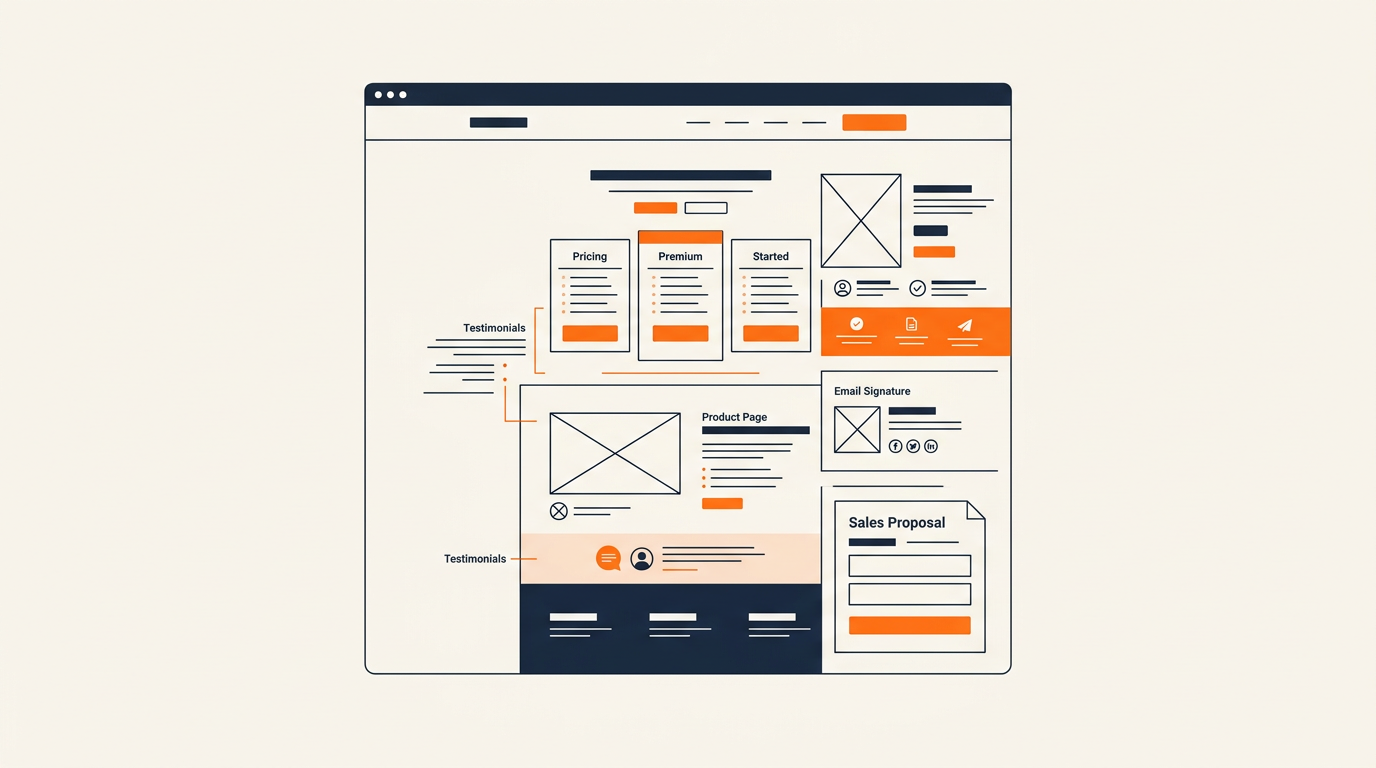
Collecting great testimonials is half the work. Where you put them determines whether they actually influence decisions.
Key finding: Testimonials placed near pricing sections improve conversion rates by 27%, compared to just 15% when buried at the bottom of the page (Teleprompter.com, 2025).
Here's where your B2B testimonials should live:
| Placement | Best Testimonial Type | Why It Works |
|---|---|---|
| Pricing page | Results-driven, Executive | Justifies the spend at decision time |
| Homepage hero | Executive endorsement | Builds instant authority |
| Product pages | Problem-solution, Implementation | Matches feature discovery intent |
| Case study pages | Comparison, Results-driven | Deep-dive proof for serious buyers |
| Proposal decks | Executive, Results-driven | Helps champions sell internally |
| Email sequences | Problem-solution | Builds empathy during nurture |
| Checkout/signup | Implementation, Results-driven | Reduces last-second hesitation |
My take: Stop putting all your testimonials on a single "Testimonials" page. That page gets the least traffic on most B2B sites. Distribute your best quotes across every page where a buyer might hesitate. A tool like Credibly lets you create smart collections and embed different testimonials on different pages, so the right quote reaches the right buyer at the right moment.
If you want more on this topic, check out our detailed guide on where to place testimonials on landing pages for maximum conversion impact.
How to Collect B2B Testimonials That Don't Sound Like Corporate Filler
The reason most B2B testimonials are bland is that the collection process is bland. Send a generic "Would you mind writing a testimonial?" email and you'll get generic results back. Every time.
Ask Specific Questions, Not Open-Ended Favors
Instead of "Can you write us a testimonial?", try:
- "What specific metric improved after you started using our product?" Forces a number into the response.
- "What were you using before, and what made you switch?" Gets you a comparison testimonial naturally.
- "If you had to explain our product to your CEO in one sentence, what would you say?" Gets you an executive-ready soundbite.
Time Your Ask Perfectly
The best moment to ask is right after a customer has a win. They just hit a milestone with your product. They just renewed. They just told your CS team something positive. That's your window, and it closes fast.
For a complete breakdown of timing strategies and email templates, read our guide on how to ask for testimonials without feeling awkward.
Use a Structured Collection Process
Random asks produce random results. You need a system:
- Identify trigger events in your customer journey (onboarding complete, first ROI milestone, renewal, expansion).
- Send a targeted request within 48 hours of the trigger, using questions matched to the testimonial type you need.
- Offer to draft it for them. Most busy executives will happily approve a quote you write based on their answers rather than writing from scratch.
My take: The single biggest improvement you can make to your testimonial program isn't better questions. It's automation. If you're manually tracking who to ask and when, you'll always be behind. Tools like Credibly automate requests tied to customer milestones, so you never miss the moment.
Want ready-made emails you can copy today? Grab our testimonial request email templates and customize them for your audience.
The B2B Testimonial Scoring Framework
Not every testimonial deserves the same spotlight. Before you put a testimonial to work, score it against these five criteria.
| Criteria | Weight | What to Look For |
|---|---|---|
| Specificity | 30% | Exact numbers, named outcomes, concrete details |
| Authority | 25% | Seniority of the person quoted, brand recognition |
| Relevance | 20% | Matches your ICP's industry, company size, role |
| Emotional Pull | 15% | Personal language, before/after contrast, enthusiasm |
| Recency | 10% | Collected within the last 12 months |
A testimonial that scores high on specificity and authority belongs on your pricing page. One that's strong on emotional pull and relevance works better in email nurture sequences. Match the testimonial to the context.
My take: I've seen companies display their oldest, most generic testimonial on their homepage because it came from a big logo. That's backwards. A specific, recent quote from a lesser-known company will outperform a vague endorsement from a Fortune 500 name nine times out of ten. Specificity beats prestige.
Credibly's AI analysis scores every testimonial across 10 dimensions, including specificity, tone, and suggested funnel placement. So you're not guessing which quote goes where. If you want to move past gut feel when deciding what goes on which page, that kind of scoring is the difference between strategic social proof and random quotes scattered around your site.
FAQs About B2B Testimonials
Here are the quick, no-nonsense answers to the questions that come up every time.
How many B2B testimonials do you actually need?
No magic number, but 15-25 active testimonials covers most B2B SaaS companies well. You need enough variety for different use cases, industries, and company sizes. More important than the total count: have at least 2-3 testimonials for each stage of your funnel. A homepage quote and a pricing page quote are doing different jobs, so they should be different testimonials.
Do B2B testimonials work better as video or text?
Both work, but differently. Video testimonials generate 2.7x more purchase decisions compared to written reviews (Zebracat, 2025). But text is easier to scan, quote in proposals, and embed across pages. My advice: collect video when you can, but always pull the best quotes into text format too. For the full breakdown, read our video vs. text testimonials comparison.
The real question isn't video vs. text. It's whether each testimonial is specific enough to move a buyer from "maybe" to "yes." Format is secondary to substance.
Can I edit customer testimonials?
You can clean up grammar and tighten phrasing, but don't change the meaning. Always send the edited version back for approval. Most B2B customers actually appreciate light editing because they don't have time to polish their own quotes. The test: if you read the edited version back and the customer would say "I didn't say that," you've gone too far.
Should B2B testimonials include the customer's full name and company?
Whenever possible, yes. Anonymous testimonials carry about half the trust of attributed ones. In B2B, the person's title and company are what give a quote weight. "VP of Sales at a mid-market SaaS company" is okay. "Sarah Chen, VP of Sales at Dataflow" is way better. Always ask for permission to use their name, title, company, and headshot.
What if my product is new and I don't have B2B testimonials yet?
Start with beta users and early adopters. Even 3-5 strong testimonials from your first customers can anchor your social proof. Focus on collecting results-driven and problem-solution types first, since those carry the most weight. You can also use social proof examples like user counts, integration partners, or advisor endorsements as bridges while you build your testimonial library.
Key Takeaways
- B2B testimonials need structure. Vague praise doesn't survive an 8-person buying committee. Lead with metrics, name the pain, or cite a specific outcome.
- Collect five types: results-driven, problem-solution, executive endorsement, implementation story, and comparison. Each serves a different point in the buyer's journey.
- Placement matters as much as content. Put results-driven quotes near pricing. Put implementation stories near signup. Don't dump everything on one page.
- Ask specific questions to get specific answers. "What metric improved?" beats "Would you recommend us?" every single time.
- Score and deploy strategically. Not every testimonial earns homepage placement. Match specificity and authority to the context where it'll have the most impact.
- Automate collection. The best testimonials come from asking at the right moment, which means building triggers into your customer journey, not relying on memory.
Turn Your Customer Quotes Into a Revenue Engine
You've got the examples. You've got the templates. Now you need a system to collect, score, and place B2B testimonials at scale. Credibly uses AI to analyze every testimonial across 10 dimensions, then tells you where each one will have the most impact.
Start your free trial of Credibly today and stop guessing which quotes belong on which page.
Written by Credibly Team
We help businesses collect and display customer testimonials that actually convert. No awkward asks. No scattered screenshots. Just social proof that works.
Try Credibly FreeAlso comparing tools? Explore testimonial software alternatives.
Continue Reading
SaaS Testimonial Examples: 11 Companies Doing It Right
See how 11 SaaS companies use testimonials to boost conversions by up to 34%. Real examples with steal-worthy tactics and data-backed strategies inside.
Ecommerce Testimonial Examples: 11 Brands Doing It Right
Real ecommerce testimonial examples from 11 brands driving sales with reviews. Products with 5+ reviews are 270% more likely to sell. Tactics included.
How to Collect Testimonials: Build a System That Scales
72% of customers leave reviews when asked, yet most businesses collect zero. Build a testimonial collection engine with proven timing, channels, and automation