Testimonial Teardown: How HubSpot Uses Social Proof (Score: 24/30)
HubSpot serves 288,000+ customers but still has blind spots in its social proof strategy. We audit every page.
HubSpot is the CRM that taught inbound marketing to the internet. They literally coined the term. With $3.1 billion in 2025 revenue (BusinessWire, 2026) and a 38% share of the global marketing automation market (6Minded, 2025), they've moved well past startup darling status.
So you'd expect their social proof to be airtight. And honestly? It's close. But "close" still leaves conversions on the table, and HubSpot has surprising blind spots for a company that teaches marketers how to build trust.
TL;DR: HubSpot scores 24/30 in our social proof audit. Their dedicated customer reviews page and data-rich case studies set the bar for SaaS. But their free tools pages ignore social proof entirely, and the pricing page could do more with the massive review library they've already built. 92% of B2B buyers are more likely to purchase after reading a trusted review (WiserNotify, 2026). HubSpot knows this better than anyone. They just don't apply it everywhere.
The Company Behind the Audit
A testimonial teardown is a page-by-page audit of how a SaaS company uses social proof -- logos, quotes, case studies, and reviews -- to drive conversions. This is the fourth in our teardown series, and here's why HubSpot earned its spot.
288,000+ customers across 135+ countries. $3.1 billion in annual revenue, up 19% year over year (Backlinko, 2026). A 38% global market share in marketing automation (6Minded, 2025). Over 1,600 app integrations in their marketplace (HubSpot, 2025).
If you want to study how a marketing-native company handles its own social proof, HubSpot is the obvious candidate. They teach the playbook. Let's see if they follow it.
My take: I picked HubSpot because they should be the gold standard. They write the blog posts about social proof. They build the tools for collecting testimonials. If anyone should have a perfect score, it's them. Spoiler: they don't. But they come closer than Stripe did.
The Homepage: Numbers First, Stories Second
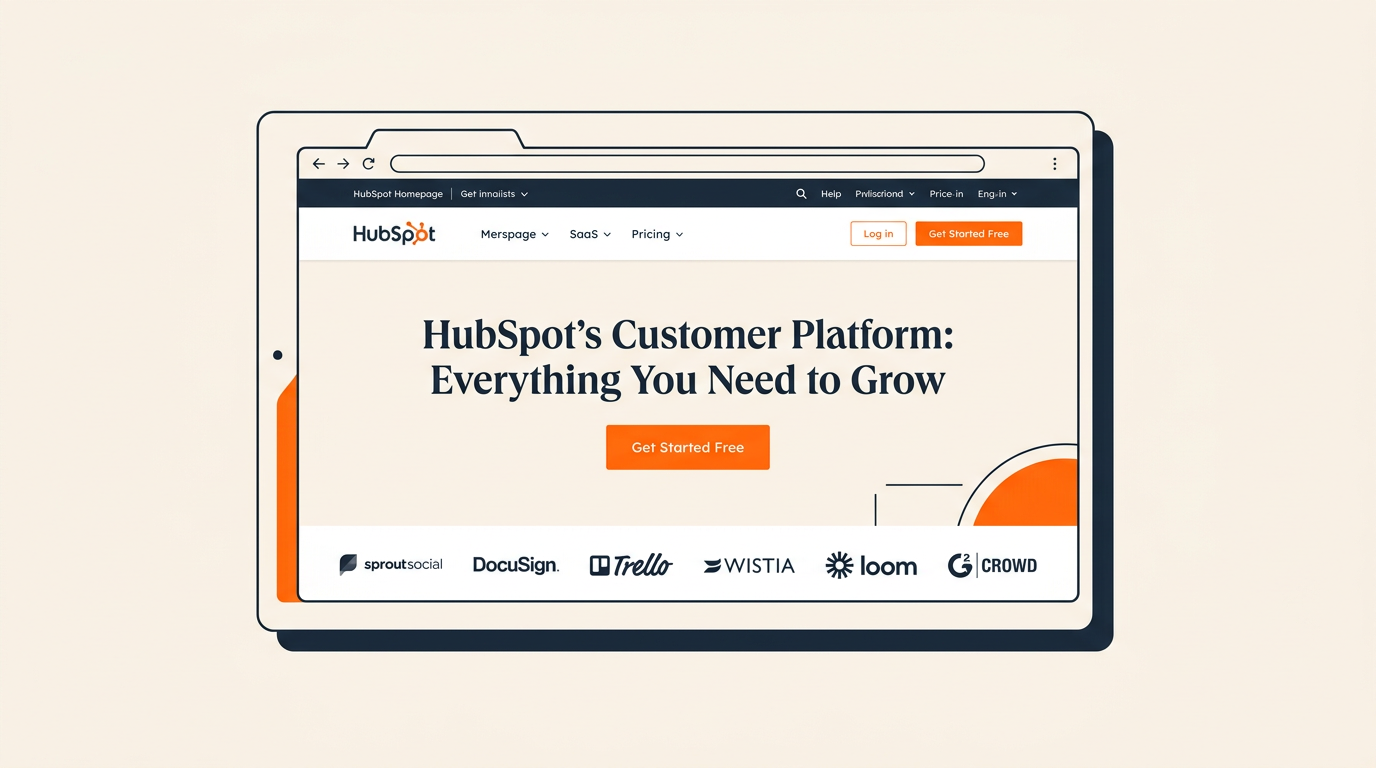
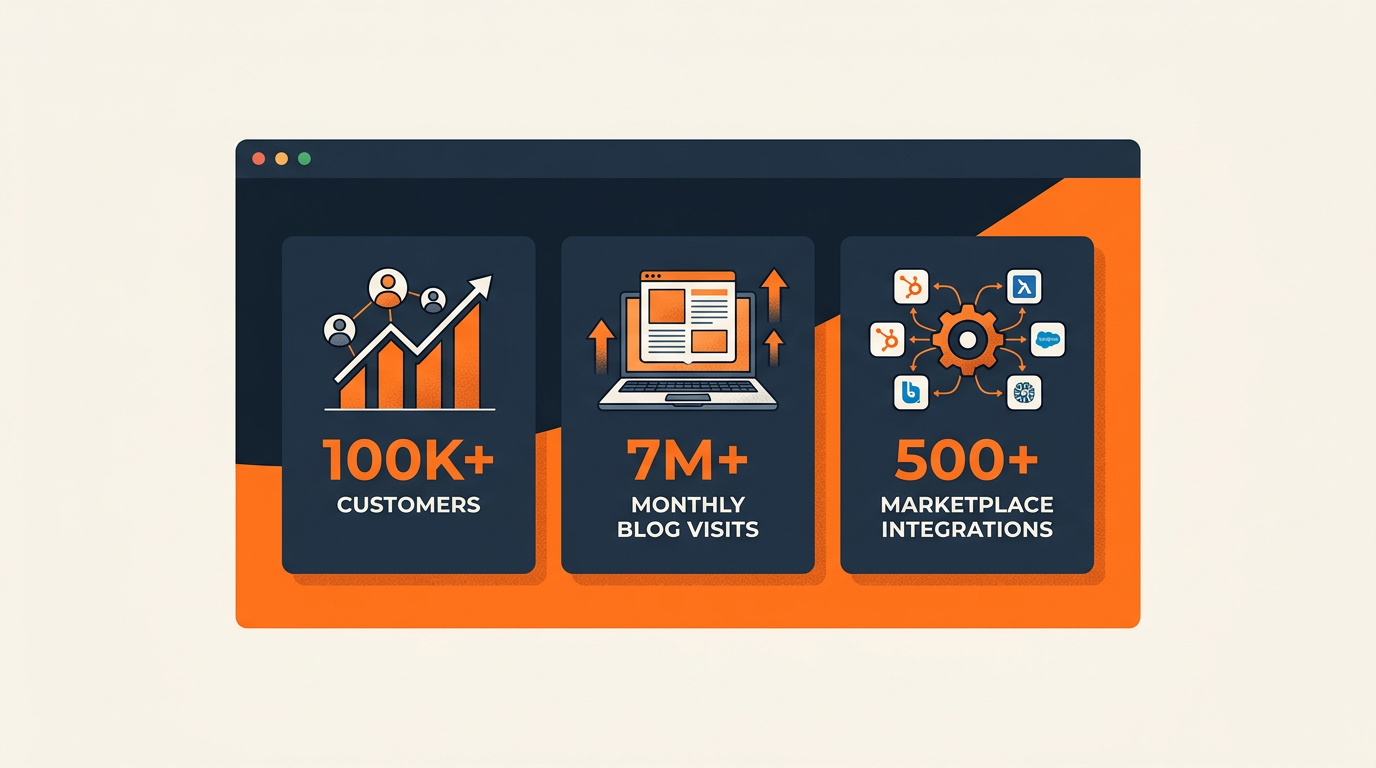
HubSpot's homepage leads with their customer platform pitch, then backs it up with hard numbers. You see stats like 228,000+ businesses trust HubSpot, along with monthly blog visits, certified professionals, and marketplace integrations. These are "wisdom of the crowd" signals, and they work. 76% of marketers say social proof boosts conversion rates (WiserNotify, 2026).
The Logo Bar
Below the hero, HubSpot displays logos from recognizable brands across industries. The selection spans enterprise and mid-market, B2B and B2C. This isn't accidental -- it's audience segmentation through brand association. A marketing director at a mid-size SaaS sees companies like theirs. A VP at a Fortune 500 sees enterprise names.
My take: HubSpot's logo bar does the same thing Stripe's does, but broader. Stripe's logos skew developer and fintech. HubSpot spans almost every vertical. Smart move when your product serves everyone from a 5-person startup to a 5,000-person enterprise. One SaaS company reported a 34% increase in trial signups after adding a Fortune 500 logo to their landing page (WiserReview, 2026). Logo selection matters more than most teams realize.
The Stats Section
HubSpot does something most SaaS homepages don't: they quantify their ecosystem. Certified professionals, monthly blog visitors, app marketplace integrations. These numbers work as implicit social proof. You don't need a quote from a customer when the numbers themselves tell the story. It's the equivalent of a restaurant with a line out the door.
What's missing? Individual customer voices. The homepage is heavy on aggregate data and light on personal stories. A single quote from a marketing director explaining why they switched to HubSpot would break up the numbers and add an emotional layer. Right now, it's all logic. Good logic, but incomplete persuasion.
The Pricing Page: Solid Foundation, Room to Grow
HubSpot's pricing page does more than most. It includes comparison tables, tier breakdowns, and links to the free CRM. Trust indicators are scattered throughout -- G2 badges and references to their customer base. That puts them ahead of Stripe's pricing page, which we scored as a "social proof desert."
But "better than Stripe" isn't the benchmark. The benchmark is what's possible.
Key finding: Sales pages with testimonials sell 34% more than those without (WiserNotify, 2026). Placing CTAs after testimonials increases conversions by 25% (WiserNotify, 2026).
What Works
HubSpot includes review badges and award mentions on or near the pricing page. G2 ratings are referenced, which is smart. 88% of consumers trust user reviews as much as personal recommendations (Trustmary, 2025). A third-party validation badge near the price is one of the simplest conversion levers you can pull.
What's Missing
The pricing page still lacks direct customer quotes near the CTA buttons. There's no "we saved X hours per month" or "we consolidated 4 tools into one" testimonial sitting next to the "Get Started" button. These micro-testimonials are the highest-ROI social proof you can add to a pricing page, and HubSpot leaves the space empty.
| Missing Element | Impact | Effort |
|---|---|---|
| Customer quotes near CTAs | Reduces "is this worth it?" hesitation | Low |
| Industry-specific testimonials | Helps different buyer personas self-identify | Medium |
| Cost consolidation quote | "We replaced 4 tools with HubSpot" | Low |
| ROI calculator testimonial | Quantifies the value claim | Medium |
My take: HubSpot's pricing page is a B+. For most SaaS companies, that would be impressive. But HubSpot has 4.4 stars from 34,000+ reviews on G2 (G2, 2026). They have more social proof ammunition than almost any SaaS on the planet. Not deploying that on the pricing page, the highest-intent page on the entire site, is like owning a Ferrari and commuting in a Civic. It works, but you're not using what you've got.
Case Studies and Customer Stories: The Crown Jewel
This is where HubSpot really delivers. Their case study directory is one of the best in SaaS, and I don't say that lightly. Filterable by industry, region, company size, and HubSpot product. Each case study follows a tight structure: the challenge, the solution, the results.
Structure That Sells
Every HubSpot case study includes:
- Named companies with real logos. No anonymized "a mid-market SaaS company" hedging.
- Up to four headline metrics. Numbers displayed prominently before you read a single paragraph.
- Executive quotes. Real people with titles putting their name behind the endorsement.
- Related case studies. Cross-linking that keeps buyers in the social proof ecosystem.
79% of B2B buyers rely on social proof when making purchase decisions (Gartner, 2025). HubSpot's case studies give those buyers exactly what they need: specifics. Percentages. Timelines. Dollar amounts.
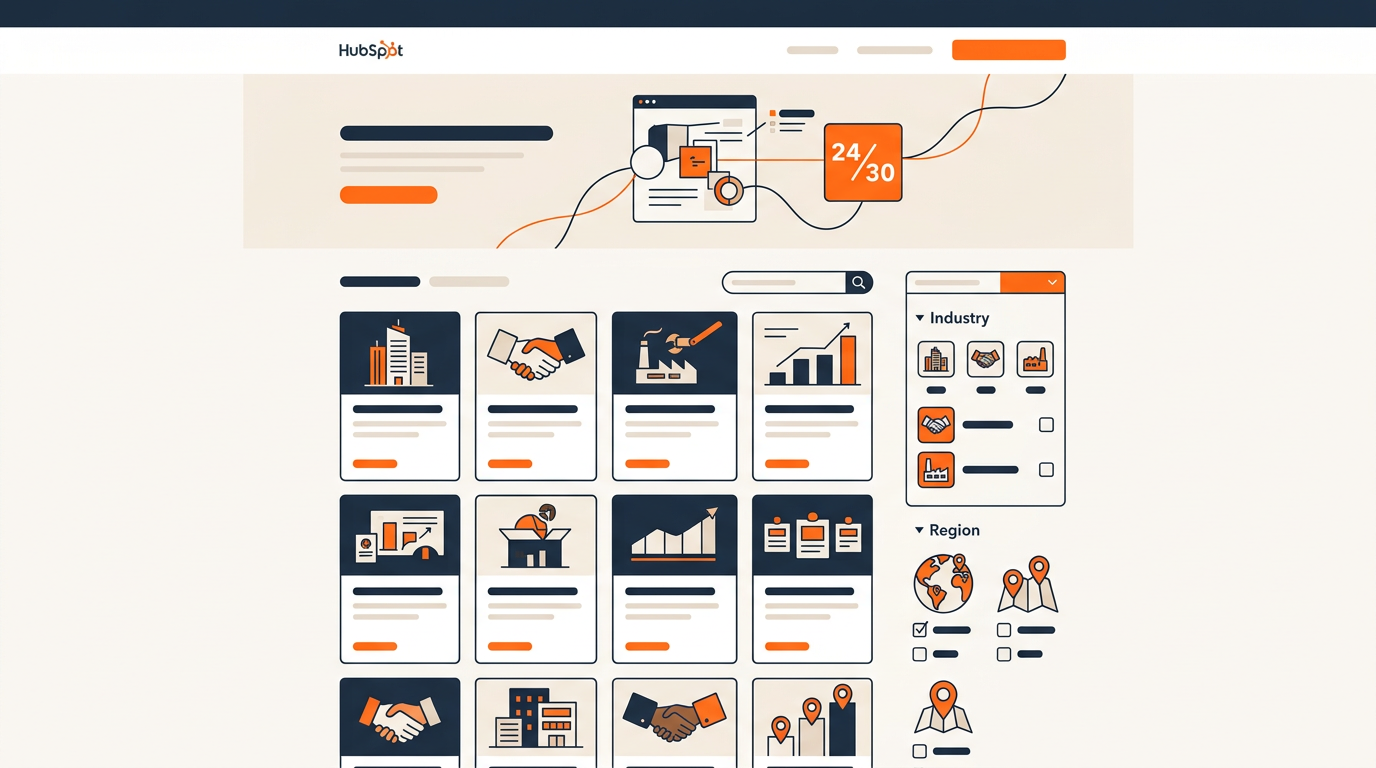
My take: HubSpot's case study library is what happens when a marketing company does their own marketing well. The filtering alone is worth studying. A VP of Sales at a healthcare company can filter to healthcare case studies and see results from companies their size. That's personalized social proof. Most SaaS companies dump all their case studies on one page and call it a day.
The Startup Stories Program
HubSpot runs a separate "Startups Customer Stories" section for their HubSpot for Startups program. Startup buyers have different concerns than enterprise buyers, and giving them their own case study section acknowledges that. It's the kind of segmentation that Credibly was built to support, letting you tag and filter testimonials so different audiences see different proof.
Where Case Studies Fall Short
The same problem we flagged in Stripe's teardown appears here: case studies are somewhat siloed. They live at /case-studies but aren't consistently surfaced on product pages or the pricing page. The best case study in the world does nothing if a buyer never sees it.
The Customer Reviews Page: A Dedicated Social Proof Hub
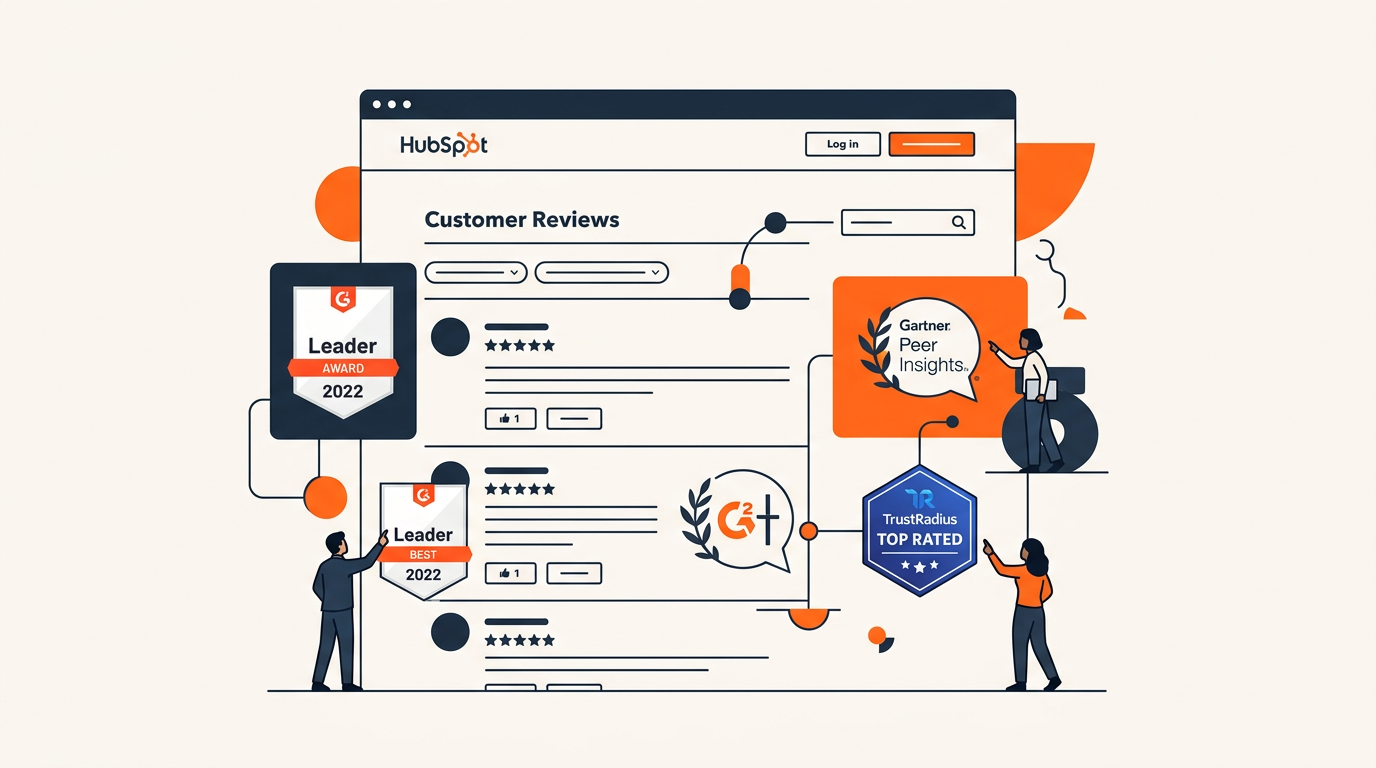
Most SaaS companies don't have this: HubSpot maintains a dedicated /customer-reviews page that aggregates their awards and review platform scores. G2, Gartner Peer Insights, TrustRadius. 90 awards from leading review sites (HubSpot, 2025). Sales Hub named G2 Enterprise Leader in 11 categories. Voted #2 Best Global Software Company on G2 in 2024.
Smart move. Instead of scattering review badges across random pages, HubSpot created a single source of truth for their third-party validation. It's the kind of page a buyer sends to their CFO when justifying the purchase.
My take: Most SaaS companies would kill for HubSpot's review profile. 34,000+ reviews on G2 alone is an absurd amount of social proof. The dedicated reviews page is a great idea that more companies should steal. But it's a destination page. Buyers have to navigate to it. The real power move? Pull those review scores onto every high-intent page on the site. A Wall of Love approach, where your best reviews are always visible, would be even stronger.
Free Tools Pages: The Biggest Blind Spot
HubSpot offers a suite of free tools: Website Grader, Blog Ideas Generator, Email Signature Generator, Make My Persona, Campaign Assistant, and more. These tools are lead generation engines. They bring in top-of-funnel traffic, capture emails, and introduce people to the HubSpot ecosystem.
And they have almost zero social proof.
Visit the Website Grader page. No customer quote about how the tool helped them improve their site performance. Visit the Blog Ideas Generator. No "this tool helped me plan 3 months of content in 20 minutes" testimonial. The Email Signature Generator? Clean, functional, and completely devoid of social validation.
This matters because these free tool pages are often a user's first interaction with HubSpot. 92% of consumers hesitate to purchase when no reviews or social proof are available (Trustmary, 2025). That hesitation applies to free tools too. People want to know the tool works before they invest their time.
My take: I've seen this pattern across dozens of SaaS audits. Companies treat their free tools like utility pages and forget that every page is a conversion opportunity. HubSpot's free tools are their top-of-funnel gateway. Adding a simple "12,000 marketers used this tool last month" counter or two customer quotes would cost almost nothing and make every tool page more compelling. This is the easiest win in the entire audit.
Product and Feature Pages: Inconsistent but Improving
HubSpot's product pages -- Marketing Hub, Sales Hub, Service Hub, Content Hub, Operations Hub, and Commerce Hub -- each tell a feature-rich story. Product screenshots, feature breakdowns, and tier comparisons throughout.
What Works
Some product pages include customer logos and references to case study results. The Marketing Hub page, for example, ties features back to customer outcomes. Headers like "trusted by 228,000+ businesses" set context before the buyer reads a single feature description.
The Consistency Problem
Not every product page gets the same treatment. Some hub pages have customer quotes, others don't. Some reference case studies, others lean entirely on feature descriptions. When social proof shows up on some product pages but not others, it creates a subtle credibility gap. The pages without testimonials feel less proven by comparison.
Products with five or more reviews show 270% higher purchase likelihood (WiserReview, 2026). HubSpot has thousands of reviews for every hub product. Surfacing even a fraction of those on each product page would eliminate the inconsistency issue entirely.
My take: Consistency matters more than perfection. I'd take a decent testimonial on every product page over amazing case studies on two pages and nothing on the rest. The absence of social proof is its own signal, and it's never a positive one. A centralized testimonial management system, like Credibly, makes it easy to assign and display the right quotes on the right pages without manual curation every time you launch a new feature.
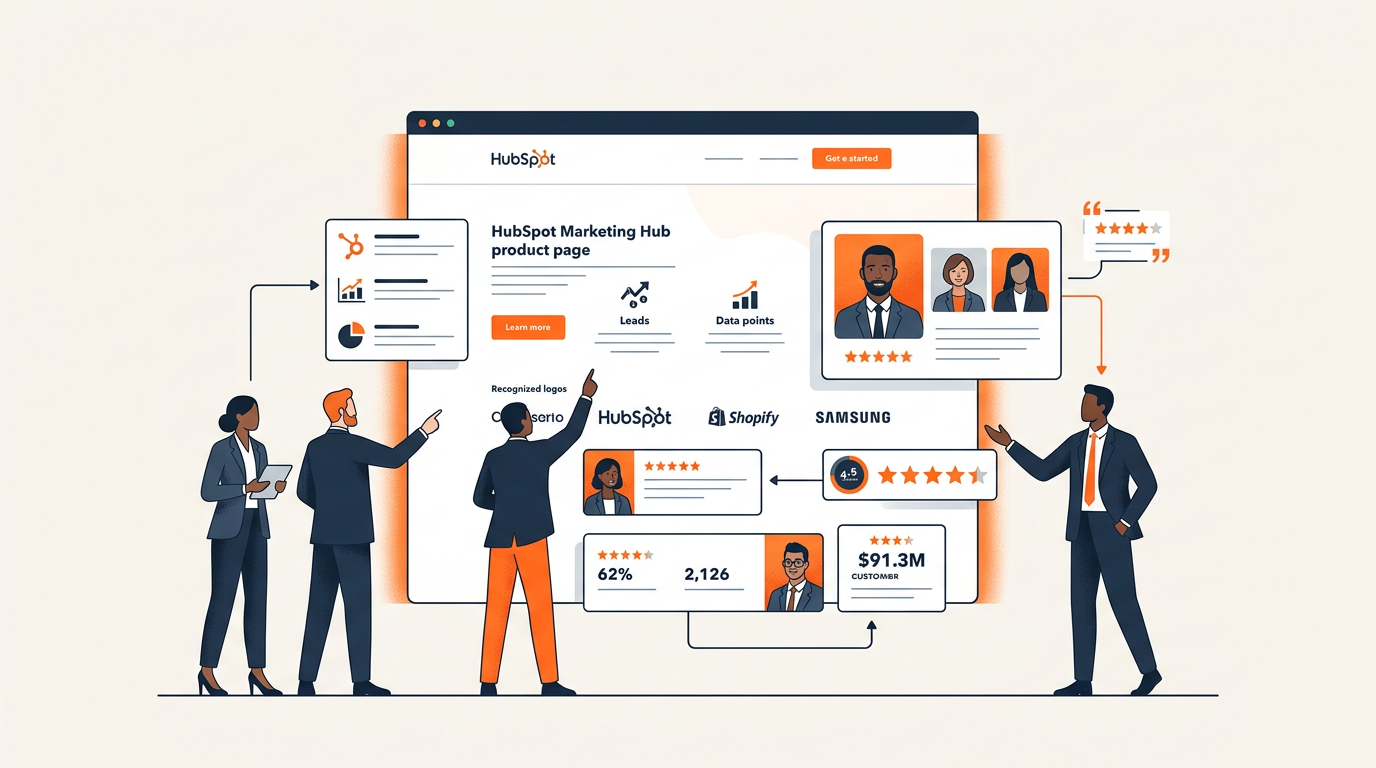
The Partner and Marketplace Ecosystem: Implicit Proof at Scale
HubSpot's App Marketplace features 2,000+ integrations (HubSpot, 2025), and the partner ecosystem is forecast to generate $17.9 billion in revenue (Crossbeam, 2025). That ecosystem is implicit social proof. Nobody builds integrations for a product they think will disappear.
HubSpot uses partner tier badges (Partner, Rising, Leading, Premier) to signal quality within the ecosystem. These help customers identify trusted implementation partners, adding another layer of third-party validation.
What's missing? Customer testimonials about specific integrations. A quote like "connecting HubSpot to Salesforce saved our ops team 10 hours a week" would make individual integration pages far more compelling. Right now, they rely on feature descriptions and install counts. The numbers are good; the human stories are absent.
Overall Strategy Assessment
HubSpot does social proof better than most SaaS companies. Dedicated reviews page, filterable case study library, aggregate trust signals on the homepage, and third-party award badges throughout. For a company that teaches inbound marketing, they practice what they preach.
But not all of it. Free tools pages are a missed opportunity. The pricing page underuses their review library. Product page consistency varies. Case studies could be surfaced more aggressively.
Video testimonials are another gap. HubSpot recently partnered with Vouch to scale video social proof (Vouch, 2025). Video testimonials drive 80% higher conversion than text alone (WiserReview, 2026). With 288,000+ customers, HubSpot has plenty of people willing to go on camera.
The Score Card
| Category | Score | Notes |
|---|---|---|
| Logo placement & diversity | 4/5 | Strong logo bars across homepage and product pages. Good industry diversity. Could segment more by page context. |
| Customer quotes quality | 4/5 | Case studies feature strong executive quotes with real metrics. Missing from free tools and some product pages. |
| Case study depth | 5/5 | Best-in-class. Filterable, metric-driven, well-structured. The startup stories segment is a nice differentiator. |
| Pricing page social proof | 3/5 | Has review badges and trust indicators, but lacks direct customer quotes near CTAs. Better than most, not as good as it could be. |
| Strategic placement | 4/5 | Dedicated reviews page is smart. Case studies are well-organized. Free tools pages are the major gap. |
| Overall consistency | 4/5 | Most pages have some social proof. Inconsistency across product hubs and complete absence on free tool pages prevent a perfect score. |
| Total | 24/30 |
Key Takeaways
- The customer reviews page is a brilliant move. A dedicated hub for third-party validation is something every SaaS should have.
- Case studies are best-in-class. Filterable, metric-rich, and segmented by audience. Study this approach.
- Free tools are the biggest blind spot. Zero social proof on your highest-traffic lead gen pages is leaving conversions behind.
- The pricing page needs customer voices near CTAs. Review badges help, but direct quotes would close more deals.
- Video testimonials are the next frontier. HubSpot's partnership with Vouch signals they know this. Execution at scale will be the differentiator.
FAQs About HubSpot's Social Proof Strategy
Here are the questions that come up most when we share this audit.
Does HubSpot use video testimonials?
They're getting there. HubSpot partnered with Vouch to scale video testimonial collection (Vouch, 2025). Video testimonials drive 80% higher conversion than text (WiserReview, 2026), so this is a high-impact bet. The site still leans on written case studies and review badges, but expect more video content as the Vouch integration matures.
How does HubSpot's social proof compare to Stripe's?
HubSpot scored 24/30 versus Stripe's 21/30 in our Stripe teardown. The biggest difference is that HubSpot has a dedicated customer reviews page and more consistent use of trust signals across the site. Stripe wins on case study storytelling depth for technical audiences, but HubSpot's broader approach serves a wider range of buyer personas. Both companies underuse social proof on their pricing pages.
Why don't HubSpot's free tools have testimonials?
My best guess is organizational. The tools team optimizes for functionality. The marketing team optimizes for conversion. Neither team "owns" the social proof on tool pages, so it falls through the cracks. A centralized system for managing and distributing testimonials -- something like Credibly -- solves this exact problem.
My take: If you're running free tools as a lead gen strategy, check out our blog for more teardowns and strategies. The pattern is almost universal: free tool pages get the least social proof attention and have the most to gain from adding it.
What's the single biggest improvement HubSpot could make?
Add two to three customer quotes to every free tool page and the pricing page. That's it. They already have the content. With 34,000+ G2 reviews (G2, 2026), they're sitting on a massive library of quotable material. Minimal effort. Significant impact based on the data. Placing testimonials near CTAs boosts conversions by 25% (WiserNotify, 2026).
Can smaller companies replicate HubSpot's approach?
Yes, and you don't need 288,000 customers to do it. The principles scale down just fine. Build a dedicated reviews page. Make case studies filterable. Add customer quotes to your pricing page. Use review badges from G2 or Capterra. Start with a Wall of Love to display your best feedback, and expand from there. The building blocks are accessible to any company willing to ask for and organize customer feedback.
Your Social Proof Shouldn't Have Blind Spots
HubSpot scores well because they treat social proof as a system, not an afterthought. But even they have gaps. The lesson: blind spots happen when social proof is managed manually across pages and teams.
Credibly fixes that. Collect testimonials from 20+ sources, use AI to surface the quotes that actually convert, and deploy them site-wide with widgets that match your brand. No gaps. No inconsistency. No pages left empty.
Start your free trial of Credibly today and build a social proof engine that covers every page.
Want us to teardown your site? Reply on Twitter @getcredibly
Written by Credibly Team
We help businesses collect and display customer testimonials that actually convert. No awkward asks. No scattered screenshots. Just social proof that works.
Try Credibly FreeAlso comparing tools? Explore testimonial software alternatives.
Continue Reading
Testimonial Teardown: How Shopify Uses Social Proof (Score: 24/30)
Shopify powers 4.8M+ merchants and $300B in GMV. We audit their social proof strategy page by page and score them 24/30.
Testimonial Teardown: How Stripe Uses Social Proof (Score: 21/30)
Stripe processes $1T+ annually but leaves conversions on the table. We audit their social proof strategy page by page.
Testimonial Teardown: How Linear Uses Social Proof (Score: 21/30)
Linear's testimonial design is the best in SaaS, but zero case studies means no enterprise close. Our full teardown.